Monday, December 5, 2011

Gil Hodges' Brooklyn Dodger teammates make a pitch for his Hall of Fame honors

The Golden Era Committee meets this weekend in Dallas at the winter baseball meetings to decide the worthiness of ten veterans and executives for Hall of Fame enshrinement. One of those ten candidates is beloved Brooklyn Dodger first baseman and manager of the 1969 New York Mets World Series championship team, Gil Hodges.

During the 15 years he was eligible for the BBWAA vote, Hodges finished as high as third in the voting on three occasions, while the next nine finishing below him (1976, 1977) eventually made the Hall of Fame. Later, various incarnations of the Veterans Committee failed to elect Hodges, while comparable players such as Orlando Cepeda (VC) and Tony Perez (BBWAA) received the call in back-to-back years.

Gil Hodges / Bowman
At the time of his retirement, Hodges’ 370 home runs were the most in the National League by a right-handed hitter. He cemented the clean-up spot in Brooklyn’s lineup, guiding them to their only World Series in 1955. At first base, his glove work was outstanding, winning the Gold Glove during for three straight years after its inception in 1957.

To the small crop of Hodges’ remaining living Brooklyn teammates, his absence from the Hall of Fame remains a mystery. Ed Roebuck, who spent six seasons with Hodges in Brooklyn and Los Angeles, as well as another two playing for him in Washington, is perplexed by his absence.

“It’s unbelievable that Gil Hodges isn’t in," Roebuck said. "Even as a manager, how would you figure the 1969 Mets to beat Baltimore? That in itself should be admission to the Hall of Fame.”

Joe Pignatano, Hodges’ long-time coach with the Washington Senators and the New York Mets, also played five seasons with him in Brooklyn, Los Angeles and New York. Pignatano sees this year’s vote as a mere formality for something that should have been done a long time ago.

“It’s absurd," Pignatano said. "This is something that is long overdue. There isn’t anybody I know that doesn’t speak highly of him.”

Hodges’ tremendous character allowed him to positively impact everyone on the team, from the established veterans, to the newcomers on the block. One such newbie was pitcher Glenn Mickens. In 1953, Mickens was a rookie making the jump to Brooklyn from AA Fort Worth. It was Hodges that welcomed him to the fold.

“[He] made me feel like I belonged there … he was a complete gentleman in every respect,” Mickens said. “I never heard a negative word spoken about Gil Hodges and I don't think that he had an enemy in the world - except maybe those opposing pitchers who couldn't get him out, and theirs wasn't negativity, but actually respect for one of the best to ever play the game.”

Catcher Tim Thompson was another rookie who was a recipient of Hodges’ benevolence. Thompson made the club out of spring training in 1954 and needed a place to stay in Brooklyn. Hodges quickly came to the rescue.

“He was the most human being I ever been around in my life," Thompson said. "When I went to Brooklyn, he said, ‘I have a house for you to rent right beside me so you have somewhere to live.’ He used to pick me up and take me to the ballpark. He was a very good friend of mine.”

On the field, Hodges had a humble approach that resonated with his teammates. They saw him give the same respect to his opponents that he did to those in his own dugout.

“Gil would hit a grand slam and would have his head down all the way around the bases like he felt sorry for the pitcher," Roebuck said. "Now they point in the sky, jump up; so unprofessional! If you did that when I played, you would have been knocked down for sure.”

The newly formed Golden Era committee which is comprised of eight Hall of Famers (one being Hodges’ teammate Tommy Lasorda), five executives and three members of the media, has a tremendous task at hand to pare down the list to one or more candidates that 75% of them agree upon. Hodges’ candidacy has sparked debate for years; however, for Mickens, this vote should close the chapter on an honor Hodges should have received years ago.

“He was an outstanding clutch hitter and his record speaks for itself as far as his being in the Hall of Fame,”  Mickens said. “I believe that his induction is long overdue and it would be a terrible disservice if they pass him up.”

Sunday, November 27, 2011

Lenny Dykstra settles in at Strawberry's restaurant

Lenny Dykstra, the much maligned center fielder for the 1986 New York Mets World Series championship team, appeared Saturday evening at Darryl Strawberry's Sports Grill in Queens. Click here to read about Dykstra's appearance and see photos from the event.


Saturday, November 19, 2011

Gil Hodges' disciples turn up the volume on his Hall of Fame chances

The topic of inductions was a hot item during Thursday night’s Winning Beyond Winning’s 14th annual Gil Hodges Legacy Dinner at the Chateau Briand in Carle Place.

Completing the ceremonial first pitch in front of a crowd of 250-plus supporters, former New York Yankees Frank Tepedino and Rusty Torres accepted their inductions into the Winning Beyond Winning “Winners Circle”.
Mrs. Joan Hodges at the 2011 Gil Hodges Legacy Dinner

Torres, who founded the organization along with attorney Tom Sabellico, helps to educate kids about the dangers of drugs and alcohol, while promoting participation in athletics. Tepedino was one of their first recruits.

“At a time in my life, when I gave up alcohol, Rusty and Tom came into it. Winning Beyond Winning was a blessing,” Tepedino said.

New York Yankees relief pitcher David Robertson and his wife Erin were presented with the Great Americans Award for their community work with their charity High Socks for Hope in their home state of Alabama.

The dinner, which bears the name of the legendary Brooklyn Dodgers first baseman and New York Mets manager, served this year as an impromptu booster party for Hodges’ Hall of Fame candidacy. When Hodges’ wife Joan took the podium for the celebration of her 85th birthday, the buzz circulated about her late husband’s Hall of Fame credentials. Hodges is one of the ten candidates on the newly formed Golden Era ballot to be voted on December 4th in Dallas.

Long time New York Mets shortstop and Long Island Ducks owner Bud Harrelson discussed Hodges’ paternal influence as his manager.

“When I was with him, I felt like I was a son and I think he made a lot of players feel like that,” Harrelson said. “I fell in love with this guy. He was not negative, always positive. … He was just a good man, a family man [with] really solid principles.”

Washington Senators outfielder Fred Valentine, who played under Hodges from 1964-67, also praised  his fallen manager's character. Hodges' treatment brought out his best on the field every day.

“Throughout my whole playing career I think I gave him 100, 110 percent while I was on the field,” Valentine said. “I knew what type of person he was. He was a devoted person, a devoted manager, and he treated all of the players equally well. All of the ballplayers seemed to like the way that he managed.”

Seeing Mrs. Hodges only reinforced his belief that it would happen soon.

“I can’t say enough about Gil Hodges about a manager. I’m just praying as I told Mrs. Hodges [today], that he will make it to the Hall of Fame where he deserves to be.”

Another Hodges disciple, Art Shamsky, felt Hodges' honor is long overdue. He hopes Mrs. Hodges will be alive to experience his induction.

“It’s certainly something that should have been done a number of years ago," Shamsky said. “Especially if you look at his stats against guys like Tony Perez and Orlando Cepeda, it’s very comparable. I’m just not sure why it hasn’t happened before. Hopefully at this point while Mrs. Hodges is around to enjoy some good news, it will happen sooner than later.”

Mrs. Hodges took a rare public moment to reflect on this renewed opportunity for her late husband to gain entry to the Hall of Fame. While she feels he is certainly deserving, their bond is what she cherishes above his Hall of Fame status.

“I’m going to be truthfully, very very honest with you,” Hodges said. “I have never really discussed this … how I feel about him, how over deserving [he is]. If it happens, we’ll be eternally grateful; if not, he’ll be in my heart forever.”

Sunday, November 13, 2011

Strincevich, 3rd oldest major league player, dies at 96

While our country was celebrating the merits of our military veterans this Friday, the baseball family was mourning the loss of World War II era pitcher Nick Strincevich. He passed away November 11th in Valparaiso, Ind. At 96, he was the third oldest living major leaguer at the time of his death.

Nick Strincevich

The first player to make the majors from Gary, Indiana, his path started on the local sandlots. In 1934, “Jumbo” caught the attention of a local bird-dog scout in Indiana while playing semi-pro ball that led to him pitching batting practice for the New York Yankees in Chicago against the likes of Babe Ruth and Lou Gehrig. By the time he arrived home from his big day at the park, he received a telegram notifying him that he was now property of the Yankees.

Entering their organization in 1935, Strincevich advanced quickly through the Yankees minor league rank, closely following his manager Johnny Neun as they climbed their way to the major leagues. Strincevich was part of the dominant 1938 Newark Bears team that had almost exclusively a future major leaguer roster including Hall of Famer Joe Gordon. Despite his 11-4 record, the Yankees did not bring him up. With their pitching rich farm system, they saw Strincevich as expendable and sold him to the Sacramento Solons of the Pacific Coast League the following season. He pitched sparingly and was purchased by the Boston Bees at the end of the 1939 season.

Strincevich found a home in Boston under manager Casey Stengel, figuring prominently in their starting rotation, pitching in 32 games during his rookie season in the National League. “Casey liked me. He used to kid me up all the time,” said Strincevich in 2003 to Craig Allen Cleve's Hardball on the Home Front.
Even though he finished the season 4-8, he showed promise for the next season, going 3-1 in his last four decisions. This anticipation for an improved 1941; however, was quickly cut short when early in the season, Strincevich was hit in the face by a thrown ball during practice. He suffered headaches that would plague him the next two seasons.

Fortunately, during the aftermath of this injury, there was a silver lining for Strincevich. It came in the form of a trade to the Pittsburgh Pirates. Sent to the Pirates for Hall of Famer Lloyd Waner, his move to Pittsburgh would earn him 40 wins from 1944-46.

So popular was Strincevich in his hometown of Gary, that he was given a day in his honor in 1947 at Wrigley Field. It would be one of the last bright spots of his career. He would only earn one more victory in the majors and was back to the minors for good the following season. He walked away from baseball in 1950 with a record of 46-49 for Boston (NL), Pittsburgh and Philadelphia. He worked as a union steward in an auto parts factory for 30 years before his 1980 retirement.

Friday, November 11, 2011

Tom Seaver reflects on the benefits of being a United States Marine

Hall of Fame pitcher and former United States Marine Tom Seaver stood proudly on the podium Friday morning as he saluted the veterans at Citi Pond in Bryant Park. The legendary New York Mets pitcher served in the Marine Corps from 1962-63, and remained on reserve duty until 1970.

Tom Seaver poses with Fordham's Color Guard at Bryant Park / N. Diunte

Seaver repeatedly expressed his respect for the members on active duty, explaining how his time in the military helped better prepare for his baseball career.

“What they taught me was so much about discipline, so much about focus, so much about team spirit,” said Seaver. “Does it sound like I'm talking about baseball? Yes it does, but it came from the Marine Corps.

“Just boot camp, you get through it and you feel like you've accomplished so much,” he said. “The things that I’ve learned, and especially learned to integrate into when I was a pitcher in the big leagues … the discipline and the focus and respect for uniform, etc., were an extremely important part of my career.”

Seaver was also joined by another Hall of Famer, 2011 Rock and Roll Hall of Fame Inductee Darlene Love, who serenaded the crowd with a riveting version of the National Anthem. Both were all smiles as they graciously signed autographs and posed for pictures with the active members on hand.

“It couldn't be more rewarding for me to see the passion that these individuals have,” he said.


Monday, November 7, 2011

Russell Rac, 81, hit four home runs in one game while with the St. Louis Cardinals organization

Mark Whiten gained notoriety when, as a member of the St. Louis Cardinals in 1993, he hit four home runs in a game against the Cincinnati Reds. While Whiten was the first Cardinal to achieve this feat, he wasn’t the first in the Cardinal family to do so. Long-time St. Louis farmhand Russell Rac set the single-game Venezuelan record when he hit four on January 8, 1956 while playing for Pastora. At the time, he was only the eighth player in professional baseball history to reach that mark.

Rac passed away October 11th in his hometown of Galveston, TX, with little fanfare at the age of 81. Some 55 years ago; however, he sat among the top of the prospects in the Cardinals organization.

Rac (c.) in between Don Blasingame (l.) and Rip Repluski (r.)
Rac’s power output in winter ball, combined with his .312 average at AA Houston in 1955, placed Rac on the cover of the March 1956 issue of Baseball Digest. The scout's take on Rac read as follows, “Murders fast ball, pulls inside pitch, but weak on curve. His bat will have to carry him, as fielding, throwing and running are only average.”

Interviewing Rac in 2008, he gave an assessment of his talents that mirrored that of the scout quoted in Baseball Digest.

“I just happened to be in the wrong organization, because I was fast, but I wasn’t fast enough for center fielders,” he said.

The momentum he built entering the 1956 season was put to a halt by Cardinals GM Frank “Trader” Lane. While playing in Venezuela, Rac picked up a copy of the Sporting News to find he had fallen out of favor with the new GM, without even talking to him.

“Frank Lane came to the Cardinals, and the Cardinals had set a record of signing all of their players way before spring training,” he said. “I pick up the Sporting News in Venezuela and he made some sort of ugly remark about not signing a contract. I never got a contract, that’s the truth. They sent it to Mexico City. Here I am playing in Maracaibo and they sent it to Mexico City. I go to spring training and everybody wants to know why I didn’t sign. I said, ‘I can’t sign a contract I never got.’”

Rac started out the winter playing in Mexico City, but switched to Venezuela without notifying the Cardinals. After some frantic searching, Lane found Rac in Venezuela and offered him a contract.

“The contract they offered me was $600 per month,” he said. “What was the big holdout? Hold out for what? I was tickled to death to go to spring training.” 

His difficulties with Lane, whether they were rightfully deserved, put him in the dog house during spring training. He received a limited chance to show that he was fit for the big leagues.

“[Lane] was a sorry guy in my book,” said Rac. “I never got an opportunity. Fred Hutchinson was the manager and I never got an opportunity to play.”

After 1956, Rac would never get another shot with the parent club, playing two more seasons until he retired in 1958, finishing up what was an 11-year minor league career. He didn’t go quietly; he batted .312 his final year, placing him among the leaders in Texas League in hitting. Back injuries, however, prevented him from continuing.

“I played [ten] seasons and I couldn’t play no more,” he said. “My back hurt and it wasn’t no fun playing.”

After baseball, Rac was fortunate enough to find work in his hometown of Galveston with the longshoremen. He was a clerk and a timekeeper. He worked in that position for 33 years until retiring in 1992.

Our 2008 conversation allowed him to reflect on some of the characters he met during his travels. The one that stood out the most was his teammate, a 19-year-old second baseman, Earl Weaver. Even as a rookie, Weaver showed traits as a player that made him such a great manager.

“You remember Earl Weaver?” Rack asked. “That was my roommate. … He was a helluva second baseman. He reminded you of [Eddie] Stanky. In other words, he couldn’t do anything great, but I tell you what, he was at the right place, at the right time, all the time.”

Rac held tight to the effects the reserve clause had on the players of his generation. With the Cardinals in full control of his destiny, he had little choice to play until they decided to promote him, trade him, or retire. He toiled in the minor leagues waiting for a chance that never came.

“Baseball is different today than it was back then,” he said. “In those days, you could be the number one player in the world and [if] they had a guy in front of you that’s been there and did a good job, you never would get an opportunity. … They held you forever.”

He paid tribute a fellow Cardinal Curt Flood and his crusade to challenge the reserve clause. He feels current players owe a debt of gratitude to Flood and should do more to honor his legacy.

“It was terrible [the reserve clause],” he said. “That’s why all [of] these players should pitch in a fund and send money to Curt Flood’s wife because of what he did. They wouldn’t have the opportunities they have today. Now they’re paying these guys three-to-four million to sign and they haven’t done anything.”

He stressed that even with free agency and million dollar contracts, the political nature of the sport has remained a constant.

“Baseball was politics and still is today,” he said. “It’s like jobs; you have to be in the right place at the right time.”

Well for Rac, one day in Venezuela, far away from the politics of American baseball, he found himself at the point where the right place and the right time met.

Sunday, October 30, 2011

Dave Cole and Roy Smalley Jr.'s deaths link a history started 57 years prior

Dave Cole and Roy Smalley Jr., remained linked long after the 1954 trade that saw them switch places on the Milwaukee Braves and the Chicago Cubs. After the late season emergence of Ernie Banks in 1953, the Cubs found Smalley Jr. expendable and sent him to the Braves for Cole during spring training. Both of their careers fizzled after the trade, neither showing the promise that either team expected after the swap.


Last week, they died four days apart. Smalley Jr. passed away at the age of 85 last Saturday in Arizona. Cole died in his hometown of Hagerstown, Maryland at 81 on Wednesday.

Their deaths, while coincidental, reminds us of the depth of baseball's connections. The news drums up nostalgia of the hope that each player brought to their new teams some 57 years ago.

Smalley began his career in 1944 with the Los Angeles Angels of the Pacific Coast League. Serving in the US Navy during World War II, Smalley returned to baseball in 1946. After some seasoning at the lower levels of minor league baseball, he became the starting shortstop for the Chicago Cubs in 1948, a position he would hold until the arrival of Ernie Banks in September 1953. Once spring training rolled around in 1954, Smalley saw the handwriting on the wall.

“Ernie had shown his talent for hitting at the end of the ’53 season. There was no hint from the club, but once into spring training in ’54, the trade didn’t come as a surprise,” Smalley in a letter he wrote to the author in 2009.


Smalley was traded to the Braves for Dave Cole in 1954 and was used sparingly as a reserve infielder. He was purchased by the Phillies the following spring, and spent parts of the next four seasons as their backup shortstop. He played in the minors through the 1960 season and then finished his career in baseball managing the Class C Reno Silver Sox from 1961-62.

His best season was 1950 when he had career highs in home runs, runs batted in, and slugging percentage. Unfortunately, he also led the league in errors, committing 51 at the shortstop position. The year 1950 had added significance for Smalley, as he married his wife Jolene.

Smalley's new bride was the sister of major league shortstop and future manger Gene Mauch, whom he would ironically later play for in 1958 as a member of the Minneapolis Millers. Keeping the family baseball tradition alive, his son, Roy Smalley III, followed in his footsteps at shortstop, playing 13 major league seasons with the Twins, Yankees, Rangers, and White Sox.


Saturday, October 22, 2011

New York Mets celebrate the 25th anniversary of World Series victory at Strawberry's Sports Grill

Strawberry’s Sports Grill in Douglaston was the site of a glorious reunion of the 1986 New York Mets World Series Championship team Friday evening. Over 25 members showed up on the silver anniversary of their title run, as part of a weekend series of events and appearances for the crew.

Fans paid upwards of $500 to mingle with the entire team at this private event and enjoy a wonderful open bar and seemingly endless buffet of food served by Strawberry’s staff. Darryl Strawberry himself was the consummate host, posing for photos and signing autographs at every turn of the corner, while catching up with teammates who came from far and wide for the reunion.

Rafael Santana (r.) toasts the Mets 1986 victory / N. Diunte
One such player was shortstop Kevin Elster, who was a baby-faced 22-year-old rookie shortstop in 1986. Coming from Huntington Beach, California, Elster relished the opportunity to see his teammates once again.

“I was just a baby,” said Elster. “I love coming back here. It’s great to be around all of the guys. You couldn’t pick a better group.”


The list of those in attendance ranged from the stars such as Strawberry and Keith Hernandez, to lesser known members like John Gibbons and Bruce Berenyi, both who played in 1986, but didn’t make the World Series roster. On this evening, these designations didn’t matter; the Mets alumni were just ecstatic to be in each other’s company.

“I always look forward to any chance I can get to see all the guys again," Berenyi said. "I don’t get to see hardly anybody anymore. I’m not involved in baseball so it’s kind of tough. Not being part of the actual series is kind of a mixed emotion thing for me, but everyone always makes me feel like I was a big part of it.”

Game Six of the 1986 World Series played on the big screen televisions at the restaurant and many, including the players, watched and cheered like it was unfolding before their eyes. One could hear a player's name beckoned any time they were at the plate or made a play in the field. Most whose names were called stopped their mingling to fixate themselves on the TV screens when they had the spotlight.

“I never watched myself playing in this actual game until right now,” said Elster as he watched his at-bat against Roger Clemens in the seventh inning. “I don’t remember the details, but I remember that I flew out.” 

Right on cue, Elster lofted a fly ball to Dave Henderson that ended the inning, to which Elster remarked, “I battled pretty good, didn’t I?”

As both the game and the party went to the later innings, everyone in attendance cheered whenever a Met got a hit or scored a run. Kevin Mitchell was seen with a wide grin when he scored on Bob Stanley’s wild pitch. The cheering grew louder with each pitch that Mookie Wilson fouled off until he bounced one to first base that slipped under the glove of Bill Buckner. As Ray Knight came around to score, Jesse Orosco high fived Rick Aguilera to congratulate him on his win.

For a small fraction of time, one had the feeling that they were in the clubhouse with the Mets as they tasted the spoils of victory. A celebratory toast was in order and everyone raised their glasses to the Mets. Once again, the Mets triumph reigned supreme in Queens.


Saturday, October 15, 2011

Johnny Schmitz | Former Brooklyn Dodger dies at 90

Johnny Schmitz, nicknamed Bear Tracks for his big feet, pitched 13 seasons in the majors, spending parts of the 1951 and 1952 seasons in Brooklyn. He passed away on October 5, 2011 in Wisconsin. He was 90.

Johnny Schmitz / Topps
Born November 27, 1920, Schmitz entered pro ball in 1938 at the age of 17 with Class D Hopkinsville of the Cleveland Indians organization. Earning a reputation for his sharp curveball, which fellow Dodgers hurler Rex Barney noted, “He could drop it in a coffee cup,” Schmitz earned a call to the big leagues only three years later with the Chicago Cubs.

Schmitz’s career was interrupted by his Naval service in World War II from 1943-45. Returning for the 1946 season, Schmitz didn’t lose a step, making the All-Star team and leading the National League in strikeouts. This would be the first of Schmitz’s two All-Star appearances, the other coming in 1948.


Schmitz came to Brooklyn from Chicago in 1951 as part of a mid-season eight-player trade that also brought heavy-hitting outfielder Andy Pafko to the Dodgers. As much as the focus was on the acquisition of Pafko, Schmitz was the key to the deal. He had great success against the Dodgers, winning 18 games against the Dodgers in his seven years with the Cubs. Now wearing the Dodger blue, they rested safely knowing they didn’t have to face Schmitz during their playoff run.

Schmitz watched helplessly from the bullpen as Ralph Branca surrendered “The Shot Heard ‘Round the World” to Bobby Thomson at the Polo Grounds during the final game of the season. With one swing of the bat, Schmitz’s World Series hopes were quickly extinguished.

“I thought, ‘There goes my World Series.’ To come so close, after being on teams on the bottom for so many years, and one pitch, there it went,” Schmitz said in a 1996 interview with Baseball Digest.

Schmitz had another chance for World Series glory the next season as he moved across town with the New York Yankees, but was traded to Cincinnati for Ewell Blackwell before the season ended. He pitched in the majors until 1956, also playing with the Senators, Red Sox, and Orioles.

After baseball, Schmitz became a greenskeeper on a local golf course until his retirement in 1990. He remained an avid fan of the game and was responsive to fan autograph requests up until the day of his passing, with members of the Sportscollectors.net website receiving signed fan mail from Schmitz only a few days before he died.

Thursday, October 6, 2011

Detroit Tigers owner Mike Ilitch found a friend in Tosheff

As the Detroit Tigers enter Game 5 of the American League Division Series at Yankee Stadium tonight, Tigers owner Mike Ilitch was once again reminded of his baseball roots. Ilitch was a minor league second baseman in the early 1950's with the Yankees, Senators and Tigers organizations. One of his teammates while playing for the Tampa Smokers of the Florida International League was the 1951-52 NBA Rookie of the Year, Bill Tosheff. Tosheff, like his contemporaries Bill Sharman and Gene Conley, was doing double duty holding down a NBA roster spot while trying to make the major leagues. Last week Tosheff succumed to cancer at the age of 85.

Mike Ilitch / DBusiness Magazine

Receiving the news of his fallen teammate, Ilitch basked in the thought via e-mail of how his fellow Macdeonian's benevolence put him on the right track with his future wife Marian.

“Bill was a good teammate,” he wrote. “I remember when he left one time to play baseball out of the country, he left his beautiful green Oldsmobile convertible. He let me borrow it to drive home to Michigan and that was the car I drove when I picked up Marian for our very first date! She thought I was really something pulling up in that car -- that car got me off to a good start with her, so I’ll always be appreciative of his generosity and friendship."

Although located on opposite sides of the country, they maintained contact, keeping a bond that was formed almost 60 years earlier.

“I have wonderful memories of Bill. We kept in touch over the years, sharing stories of what we both were doing. I will miss him.”

Tuesday, October 4, 2011

Bill Tosheff, first NBA rookie of the year, moonlighted as a strong armed pitcher

Bill Tosheff, the 1951-52 NBA Co-Rookie of the Year, passed away this weekend due to complications from rectal cancer at the age 85 according to a statement by his daughter on his Facebook page.

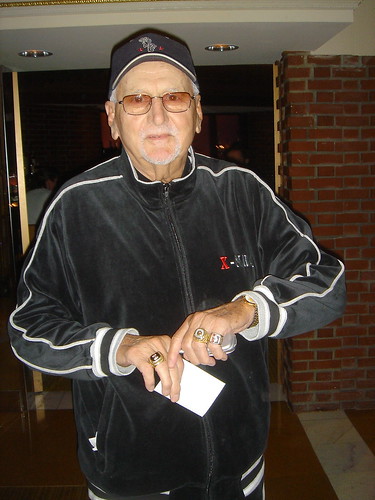
Tosheff showing off his bling
“Tosh,” as he was affectionately known to seemingly everyone, actually left his burgeoning basketball career for another sport, baseball. For someone that didn't make the major leagues, during his seven-year minor league career, he was party to more than anyone could imagine.

A three-sport star at the University of Indiana, Tosheff helped lead the Hoosiers to a Big Nine title in 1949. Blessed with a strong arm and a powerful bat, Tosheff drew considerable attention playing semi-pro baseball during the offseason.

Playing for the Lafayette Blue Sox in 1952, Tosheff threw a no-hitter during the first game of a doubleheader and smacked two home runs during the second game. That was enough for Hall of Famer and Cleveland Indians scout “Red” Ruffing. After the game, Ruffing told Tosheff to write his own ticket to the show.

“He said, ‘What is it going to take?’ I said, ‘Well, give me a number.’ We kind of played around a bit and we came to $20,000 which was pretty good in those days,” Tosheff said during a 2009 interview via telephone.

A signing bonus of $20,000 would have gained considerable press at the time; however, there was one person standing in between the money and him, Indians General Manager Hank Greenberg.

“There was a battle going on in Cleveland between Hank Greenberg and a guy named Egan," he said. "Greenberg refused my salary and Indianapolis wanted to sign me. I think I signed for $2,500 per month which wasn’t bad.”

Three days after his signing, he was the starting pitcher for the Triple-A Indianapolis Indians. One step away from the major leagues, Tosheff found himself surrounded by legends in the twilight of their careers, as well as stars on the rise. His catcher that evening was the legendary Negro Leaguer, Quincy Trouppe. A 20-year veteran, Trouppe had a cup of coffee earlier in the season with the Indians, forming the first black battery in the American League with Sam Jones. Ironically, both played with Tosheff in Indianapolis. Tosheff shared his memories of his debut with Trouppe as his battery mate.

“He was my catcher the first time I pitched," he said. "Let me tell you about the experience. I was the starting pitcher against Louisville on July 4th. They brought my parents in from Gary. When I got on the mound to throw the first pitch, it looked like the home plate was three miles away from me. It was one of those excitable things.”

At the age of 25 and a veteran of World War II, Tosheff was in the unique position as a rookie to serve as a mentor to the younger players on the club. One of the fellow pitchers he took under his wing was Herb Score. Tosheff would later use his experience with Score to serve as an advisor to current Colorado Rockies third baseman and fellow Macedonian Kevin Kouzmanoff.

“When I was there, Cleveland signed another kid for $75,000 [sic], his name was Herb Score," he recalled. "This guy was throwing aspirin tablets as a left-hander. We lived in the same apartment and I kind of mentored him because I was older. He had no father image. He was raised with his mother. We had a check on the table for $12,500 and he didn’t know what to do with it. I sent it to his mom in Florida.”

Incredibly, in the same league, Tosheff wasn’t alone as an NBA player trying to crack a major league baseball roster. In 1952, The American Association was loaded with NBA stars. St. Paul had Boston Celtic and future Hall of Famer Bill Sharman. Milwaukee had Sharman’s Celtic teammate Gene Conley and another future Hall of Famer Andy Phillip played with Tosheff briefly in Indianapolis. In addition, Milwaukee first baseman George Crowe was a professional basketball player for the New York Harlem Rens.

Released after the 1952 season as per the terms of his contract, Tosheff played the next three seasons at the Class B level, where he posted consecutive 20-win seasons. While with the Tampa Smokers, another stop in Tosheff's baseball odyssey occured in Cuba. It was there he rubbed elbows with author Ernest Hemmingway. After a chance meeting at Bar Cristal, he offered Hemmingway tickets to the ballgame. Sparking a conversation, the author invited him to imbibe, urging him to, “Sit down and have a taste.”

Running around Cuba with Tosheff was a second baseman from Detroit who would be better known for his pizza than his exploits with his glove. Mike Ilitch, the founder of the Little Caesar’s Pizza chain and owner of the Detroit Tigers and Red Wings, was Tosheff’s teammate in Tampa. At the end of the season, Tosheff was offered an opportunity to get in on the ground floor of Ilitch’s operation; however, he was occupied with leaving the country.

“I had a brand new Olds 98 convertible," he said. "After the season was over, I said, ‘Well, look I’m going to go to South America, I quit the NBA, take my car to Detroit."

Before they parted company, Ilitch posed him an offer.

"Before he left, he said to me, ‘Tosh, there is a guy who has a little bar in Detroit and my mom gets this great sauce and the secret is in the sauce. You and I will be partners.'”

Tosheff, who focused on the prospect of playing baseball out of the country, just wanted to leave as soon as possible.

“I said, ‘Mike take the car and go to Detroit. I want to go to South America.’ I went to Cartagena, Columbia and played baseball. A year later I came back and got my car; he got married.”

Chance would reunite them thirty years later. After watching Ilitch being interview by Howard Cosell on television about his purchase of the Detroit Red Wings, Tosheff picked up the phone.

“I get to his secretary and I say, ‘Don’t tell him who I am.’ So he gets on the phone and goes, ‘Yeah?’ and I said, ‘The secret’s in the sauce!’ He starts laughing.”

After his playing days were over, he became an advocate for the forgotten old-timers of his era.

In the wake of the current NBA labor struggles, Tosheff was a driving force in helping the players who played in the NBA prior to the formation of the players’ union in 1965 to receive pension benefits. The group of players dubbed the “Pre-65ers” became Tosheff’s fighting cause for over 30 years.

Due to his efforts, in 2007, the NBA finally raised the pension amounts for those that had at least five years of service and expanded the benefits to include those with three or four years of service. Similarly, MLB followed suit this fall, making payments to those who fell into a similar pension gap. One can only think that Tosheff’s work had some level of influence on their union.

As he stated in the interview, he ended every talk and public appearance he made with the following bit of advice.

"The clock is always running on us," he said. "In the end result, all you have left are your memories. If they are not good ones you’ll have a hard time sustaining the rest of your life. So pull out the good ones, show ‘em the bad ones if you have any, and get after it and talk about them because someone might be interested."


Saturday, October 1, 2011

Eddie Bockman | MLB veteran and scout that signed Larry Bowa, dies at 91


On the eve of the opening game of the ALDS playoffs, Yankee fans had a moment to pause. Another one to wear the pinstripes left their ranks. Joseph “Eddie” Bockman, a rookie third baseman with 1946 Yankees, passed away Thursday at his home in Millbrae, Calif. He was 91.

Bockman’s career was almost over as soon as it started. He first signed with the Class D Bisbee Bees of the Chicago Cubs organization in 1939. After playing in 62 games with a .285 average, Bockman was nose-to-nose with one of baseball’s harshest realities, being released.

Eddie Bockman / Bowman
I wasn't doing that bad. … I sat around a whole day trying to figure out why,” said Bockman in a 2009 interview I conducted with him via telephone. “It was quite a while after I got released, two to three weeks before they went out and hired someone else. I couldn't understand it. You're just a kid at that time and you can't really put it together.”


Bockman dusted himself off and drew the attention of the New York Yankees, signing to their Class A team in Joplin the following season. As he started to move up the ranks, another team requested his services, the United States Navy.

Bockman joined the Navy in 1943 and was stationed in San Diego. It was here that Bockman would begin to mature as both a man and a ballplayer.

“As I got older, I did well in the Navy," he said. "Of course, you weren't playing against the competition as good as you did in professional baseball, but it was a ballgame. Over the course of two to three years, I played well, even if I say so myself!”

During his service time, Bockman would team up with many budding major league stars as a member of the Long Beach Service Stars.

“We had a good ballclub. Ray Boone, George Vico, Charlie Gilbert, Cliff Mapes and Bob Lemon were all with us.”

Returning to the Yankees organization in 1946, Bockman’s skills gained by playing in the Navy allowed him to make the jump to the Kansas City Blues of the Class AAA American Association. Bockman feasted on the league’s hurlers to the tune of a .303 average with 29 stolen bases. This led to a late September call-up by the Yankees that also included future Hall of Famer Yogi Berra.

Despite playing alongside such legends as Joe DiMaggio, Phil Rizzuto, and Bill Dickey, it was Bockman’s trade to the Indians with Joe Gordon for Allie Reynolds during the offseason that would place him in a front row seat to an even bigger piece of baseball’s history.

On July 5th, 1947, Indians owner Bill Veeck ushered Larry Doby in to the clubhouse, seeking to integrate the American League. Bockman vividly recalled a timid Doby making his way into the fold.

“In the clubhouse, the day he walked in, in Chicago, he was scared to death," he said. "He didn't know what to expect.

“He was different than Jackie Robinson. Robinson was a cocky guy. If he disagreed with you, he'd be ready to fight you. Doby was the other way. [He was] kind of a laid back guy, a good kid. I got along with him well.”

Bockman was used sparingly for the remainder of the 1947 season and was then purchased by the Pittsburgh Pirates. He spent two seasons as part of their third base platoon and then continued in the minors as a player-manager through the 1958 season.

He used his extensive career as a player and manager to transition into a scouting role with the Philadelphia Phillies. He left his mark on the 1980 World Series Championship team by signing seven of the members of that club, including his most prized recruit, Larry Bowa.

“He was very easy to sign," he said. "He wanted to play and nothing was going to stop him. When I went over to sign him, he jumped in the back seat of the car. That's the term we use when we didn't have any problems signing the player.”

Bowa carved out an All-Star career with the Phillies. He marveled at Bowa’s durability despite the shortstop's small stature.

“He played 16 years in the big leagues and I said he was pretty damn lucky to play that long in the big leagues and never was hurt," Bockman said. "He was always there, never a broken bone, a sore arm, or bad legs. There wasn't a hell of a lot on him to hurt! He got 100% out of his ability. He wasn't scared to work. You had a hell of a time getting him off the field. I had to pull him off the field a few times, he didn't want to leave.”

During our 2009 conversation, Bockman, using his scouting eye, took a humble assessment of his abilities.  As a scout, Bockman questioned whether he would sign himself.

“I wasn't that good of a player. I look back on myself now; I was good enough to get there,” said Bockman. “I scouted for 45 years and I would stop and think sometimes if I would scout myself [with] my abilities. I'd say to myself, ‘Shoot, I wouldn't sign myself.’”

Despite his post-playing reservations about his abilities, Bockman found a redeeming quality in his desire to be on the field.

“I liked to play and it bothered me when I wasn't in the lineup; I wanted to play," he said. "That was a factor of why I got signed in the first place. I had the ambition and I wanted to play. I didn't care where or who I was.”


Monday, September 26, 2011

Ralph Branca: A Moment in Time - Book Review

The essence of a man’s life cannot be captured by any singular event or circumstance. Ralph Branca’s new autobiography A Moment in Time: An American Story of Baseball, Heartbreak and Grace (Scribner, 2011), attempts to quell the notion that his career is summarized by the high-inside fastball he threw to Bobby Thomson on October 3rd, 1951.

Informed by one of his Detroit Tiger teammates in 1954 of the Giants intricate sign-stealing system that included a buzzer system and telescopes, Branca held on to his secret for decades. Battling the burden of bearing the weight of the hopes of an entire city being dashed by one pitch, Branca finally felt that the time was right to illuminate his career after being quiet for so long.

Click here to see video of Branca discussing his new book, as well as to read the entire review.

Saturday, September 17, 2011

Bill 'Ready' Cash, veteran of eight Negro League seasons dies at 91

Bill “Ready” Cash, an All-Star catcher with the Philadelphia Stars of the Negro Leagues from 1943-1950, passed away Monday at Roxborough Memorial Hospital in Philadelphia. He was 91.

Born February 21, 1919 in Round Oak, Georgia, Cash moved to Southwest Philadelphia as a youngster, where he honed his baseball skills on the local sandlots. After quitting his high school team, as he was the only black player on the squad, he starred on local semi-pro teams in the early 1940s. Under the tutelage of Negro League veteran Webster McDonald, he was brought to Philadelphia manager Goose Curry in 1943 and was invited to join the Stars.


Cash played eight seasons in the Negro Leagues, all with Philadelphia. He was selected to the East-West All-Star game in 1948 and 1949; during the latter which he caught the entire game. In demand for his prowess behind the plate, the well-traveled catcher played in the Dominican Republic, Mexico, Cuba, Venezuela, and Canada.

I had the opportunity to meet Cash in 2008 at an event at the Philadelphia Convention Center. Even at his advanced age, he rattled off names and explicit details of legends such as Ray Dandridge, Buck Leonard, Josh Gibson and Satchel Paige. I marveled at the size of his hands, which were not only huge, but disfigured from the multiple broken fingers due to the hazards of catching. I only wondered about the power of those hands during his prime.

He earned the nickname “Ready” after being taken out of a game early in his tenure.  He wasn’t happy about the benching and quickly told the manager, "When I put on the uniform, I'm ready to play." The moniker followed him the rest of his career.

A few years after major league baseball integrated, the Chicago White Sox signed Cash at the age of 33. Fueled by the promise of a spot with Class-A Colorado Springs, Cash batted .375 during spring training, besting fellow Negro League alum Sam Hairston’s .214 average. Despite his torrid spring, the White Sox executives did not hold up their end of the bargain and sent Cash to Class B Waterloo. Infuriated, Cash asked for his release.

“I was mad because they lied to me,” he said in Brent P. Kelly’s Voices from the Negro Leagues.

Reluctantly, Cash stayed on with Waterloo, seeking to prove his major league worthiness. His aspirations were derailed when he broke his leg less than 40 games into the season and was shelved for nine weeks. Upon his return, he was reassigned to Class C Superior to help them in their playoff run. It would be the end of Cash’s quest to get to the major leagues. He played a few more years in the Mandak League as well as with a semi-pro outfit in Bismarck, North Dakota before finishing in 1955.

Even at the end of his career, Cash’s skills continued to impress. During a 2008 interview I conducted with his Bismarck manager Al Cihocki, the mention of his name elicited an excited response.

“How about Bill Cash? Holy Christ, boy could he hit and throw. If he was playing today, he would be worth a fortune.”

Thursday, September 15, 2011

Carl Erskine talks sign stealing and the 1951 Giants and Dodgers rivalry

Carl Erskine was one ill-placed curveball from possibly changing the fate of the 1951 playoff between the Brooklyn Dodgers and the New York Giants.


When manager Charlie Dressen checked with his coach Clyde Sukeforth on the status of both Erskine and Ralph Branca to relieve a tiring Don Newcombe, Sukeforth replied, “He [Erskine] just bounced his curveball.” A few pitches later, Bobby Thomson stepped up to the plate and blasted the infamous home run off of Ralph Branca that became widely known as “The Shot Heard ‘Round the World.”


This is Part 5 of a series of interviews with Brooklyn Dodger great Carl Erskine about his experiences playing with the storied franchise. Erskine appeared recently in New York on behalf of the Bob Feller Museum and was kind enough to grant us access to produce this series of vignettes regarding his career.

Much speculation has developed as to whether the Giants were using a sign-stealing system that gave Thomson advanced knowledge of Branca’s inside fastball. Author Joshua Prager drew an admission from the late Giants third-string catcher Sal Yvars in his book, The Echoing Green, that the Giants were indeed relaying pitch information to their hitters. Thomson, however, until the day he died, vehemently denied that he had any knowledge of Branca’s offerings.


Erskine, who has often discussed his recollections of that fateful October day in 1951, didn’t seem to have ill feelings about the issue of sign-stealing 60 years later.

“Well, if you go to that year, ’51, there is no rule that I know of about using a telescope or a set of binoculars to steal signs,” he said. “It’s always assumed that ethically you steal them on the field, second base, or if the catcher is a little sloppy so that the first base can see, or some mannerism that the catcher does every time he calls a curveball his elbow goes out. Other than the ethics involved of mechanically stealing, baseball didn’t have any rule against it.”

That’s not to say that Erskine didn’t have his suspicions about it taking place across the league.

“We used to think Chicago, with that scoreboard in Wrigley Field, where they used to hang the numbers, there are big openings,” he said. “Those guys probably stole signs from the scoreboard; nobody ever checked it.”

Special thanks also goes to the promoters of JP Sports' East Coast National Show for accommodating us during Mr. Erskine's appearance.


Thursday, September 8, 2011

Carl Erskine explains how Roy Campanella helped to stabilize the Brooklyn Dodgers pitching staff

Carl Erskine and Roy Campanella were battery mates for Campanella’s entire ten-year career with the Brooklyn Dodgers. If anyone should know a thing or two about how Campanella handled the pitching staff, it’s Erskine.

Roy Campanella and Carl Erskine
This is Part 4 of a series of interviews with Brooklyn Dodger great Carl Erskine about his experiences playing with the storied franchise. Erskine appeared recently in New York on behalf of the Bob Feller Museum and was kind enough to grant us access to produce this series of vignettes regarding his career.

Campanella wasn’t exactly a rookie when he joined the Dodgers; he had been playing nine years in the Negro Leagues, learning from Hall of Famer Raleigh “Biz” Mackey. For those familiar with Campanella's lineage, it was of little surprise then that Campanella skillfully handled his pitching staff.

“What Campy did more than anything else with the pitching staff, was how he made you pace yourself,” Erskine said. “Pitchers are always overanxious, especially if you have a bad pitch or you throw a home run or something.  You want the ball back, you want to go again; he wouldn’t let you do that, he made you stay within yourself.” Although Campanella should have worn a sign saying, “Thou Shalt Not Steal”, because he threw out 51% of would-be base stealers during his career, it was his mental approach to the game that set him apart from other receivers at the time.

“His savvy ... that’s something you can’t describe; he just had a feel for the game,” Erskine said.

Erskine described how Campanella's "feel" helped to mold on one of the mainstays of Brooklyn’s rotation, Don Newcombe.

“Campy … was great at the mind game,” he said. “What to throw, when to throw it. … He was an easy personality. He helped [Don] Newcombe a lot because Newk was a little volatile and he was one of the early blacks. He had to face a lot of the indignities, same as Jackie [Robinson] did. He wasn’t handling that as well as Jackie probably, so Campy was a real soothing influence on Newcombe.” Campanella’s ability to handle the pitchers was so esteemed, that the coaching staff gave Campanella wide latitude with his charges.

“The manager would basically say to the pitching staff … ‘If you shake Campy off, you better have a good reason,” he said. “He’s been around, he knows what to do; you kinda follow Roy.’ So Roy used to say to the young pitchers. ‘Now you young pitchers, you just throw what ‘Ol Campy calls and I’ll make you a winner!’" Sometimes, Campanella would lead them down a path that was not always victorious. Erskine took the opportunity to remind him that the loss went next to his name, not the catcher after a loss. “So I’d lose a game and I’d bring him a box score,” Erskine said. “His locker was right next to mine. I’d say, 'Hey Campy, look at this! It says Erskine losing pitcher. Shouldn’t that say Campanella, losing catcher?'"

Campanella gave a quick-witted reply.

“Well you would always shake me off!”

Thursday, September 1, 2011

Bernie Williams placed among Latino baseball legends

The Latino Baseball Hall of Fame (Salon de Fama del Beisbol Latino), located in La Romana, Dominican Republic, announced its Class of 2012 selections at the MLB offices Thursday. Leading the class of 2012 was the much revered New York Yankees outfielder Bernie Williams. The Puerto Rican centerfielder was among a panel that included Latino Baseball Hall of Famers Felipe Alou, Minnie Miñoso and Tony Perez.

Minnie Minoso, Felipe Alou, Tony Perez, and Bernie Williams / N. Diunte
While much of the attention centered on the announcement of Williams’ selection, the San Juan native humbly deferred to the legends seated to his left. The first person he mentioned in his impromptu speech was Miñoso who is potentially a candidate for the Hall of Fame in Cooperstown with the introduction of the “Golden Era” ballot, which reviews the candidacy of players between the years of 1947-1972. Williams expressed fond memories of hearing the praises of the “Cuban Comet” in his household as a youngster.

“Everybody in my family knew about the great feats of Minnie Miñoso," Williams said. "When they talked about great baseball players in my household, they would say, ‘Minnie Miñoso es [un] tremendo pelotero.’ I always grew up listening about him even though I never saw him play, but I saw him through the eyes of my family."

Starting as a 16-year-old playing for Caguas in the Puerto Rican Winter League, Williams beamed with pride while speaking about his first manager who also happened to be fellow panel member, Felipe Alou.

“Felipe, he was my first manager," he said. "As a 16 year old, I remember taking off after high school going to Criollo de Caguas. It was my first team and he was my first manager. It was just a great experience and he was like a father figure to me.”

Alou has been a driving force in the formation of the Latino Baseball Hall of Fame. Enshrined in their first class, Alou is promoting the heritage of Latinos in baseball through the museum.

“This is probably my last baby in my career," he said. "I think this is big for many reasons; big because of all of the great players that are becoming and have become and will become part of this project. There are so many great Latin players who are really short in Cooperstown.”

Alou hopes to enlighten the younger players and the rest of world about the great players of the past. The Latin influence in baseball is one he feels that needs to be both preserved and celebrated.

“The Latinos, there are not a whole lot of history that today’s player know," he said. "We know, those of us that are here, that it took over 100 years to get all of these Latino players in the Hall of Fame. We would like for the Latino players and also the American people to know some of those players of Cooperstown quality, so they know where we all came from and where they came from and where we are going.”

Sunday, August 28, 2011

Carl Erskine explains how he composed his curveball in Cuba

On the verge of his 21st birthday, fresh off his first full season in professional ball, Carl Erskine found himself in a place that was in stark contrast from his hometown of Anderson, Indiana.


In the winter of 1947, Erskine was sent to Cuba to play with the Cienfuegos team at the urges of Branch Rickey. Erskine would quickly be introduced to a different climate that had nothing to do with the weather.


Saturday, August 27, 2011

Joe Caffie Indians outfielder who started in the Negro Leagues, dies at 80

Joe Caffie, the Cleveland Indians an outfielder who started with the Cleveland Buckeyes of the Negro Leagues in 1950, passed away at his home in Warren, Ohio, on August 1st, 2011. He was 80.


"I have seen a lot of fast ones, but Caffie is the fastest, and that includes guys like Sam Jethroe," the legendary Luke Easter said in Moffi & Kronstadt’s Crossing the Line.

Caffie had his start as an outfielder with the Cleveland Buckeyes of the Negro Leagues in 1950, before being signed by the Indians in 1951. He died at his home in Warren, Ohio, on August 1st, 2011. He was 80.

Speed was his trademark, which was evident when he led Class-C Duluth with 18 triples and a .342 batting average in 1952. He led the league in six batting categories en route to winning the MVP award for the Northern League, which earned him a promotion to AAA Indianapolis.

Caffie continued to perform well at the AAA level, swiping bases, legging out extra-base hits and covering much ground in the outfield. Finally, Caffie was brought up to the Cleveland Indians in September, 1956. He hit .342 in 12 games and played without making an error on defense.

Unfortunately for Caffie, he did not make the club out of spring training in 1957. With the emergence of young stars Roger Maris and Rocky Colavito, as well as the veteran presence of Al Smith and Gene Woodling, manager Kerby Farrell could not find a spot for Caffie in the crowded Indians outfield.

Determined to find his way back to the major leagues, Caffie batted .330 for AAA Buffalo, making the International League All-Star team. When the Tribe optioned catcher Dick Brown in early August, Caffie was summoned from Buffalo. Only a few weeks later against the New York Yankees, Caffie would have what was his best game in his major league career, going 4-5, while swatting his first major league home run. He finished the season with three round-trippers in only 89 at-bats.

He spent the next three seasons at the AAA level, never receiving the call to return to the majors. He ended his playing career in 1961 with Charlotte. He returned to Warren, where he worked as a laborer at Thomas Steel for 37 years before retiring.

Friday, August 26, 2011

Negro League legend Willie 'Curly' Williams left a lasting impact on many

Another eagle has ascended to the soaring skies and taken the legend of the Negro Leagues with him. Willie “Curly” Williams, infielder for the Newark, Houston and New Orleans Eagles of the Negro Leagues from 1945-51, died Tuesday in Sarasota, Florida. He was 86.

I had the good fortune of spending an entire day with Williams in September, 2007 as the city of Newark, New Jersey featured an all-day tribute to the Newark Eagles. Streets in Newark were named after former Eagles legends and the players were honored by the mayor in a private ceremony at the baseball stadium in Newark. Later in the day, the players spoke at the New Jersey Historical Society before being celebrated on the field before a Newark Bears game.

Willie "Curly" Williams (r.) with the author in 2007
Williams radiated as he spoke about his glory days in Newark, holding nothing back about both the highlights and hardships of his career. For a few short hours, Williams transformed into a man of his youth sixty years prior, as he spoke with such vigor about his life in baseball.


Born May 25, 1925 in Holy Hill, South Carolina, Williams was a shortstop for the 1946 Negro League Champion Newark Eagles which featured future Hall of Famers Leon Day, Larry Doby, and Monte Irvin. The departure of Irvin to the New York Giants in the following years opened up the shortstop position for Williams.

With the reins of shortstop secured in his hands, Williams flourished, earning a selection to the 1950 East-West All-Star game in Comiskey Park. By the following season, Williams signed with the Chicago White Sox organization and reported to their Class-A Colorado Springs affiliate.

For Williams, like many black players in the 1950s, playing minor league baseball in a small town was a cold reminder of the isolation they faced due to Jim Crow segregation.

“I went out to Colorado Springs, ain’t too many black people in Colorado," Williams said during a 2007 interview in Newark. “They found a preacher’s house for me to stay in. One black preacher was in that town; they found that house and that’s where I stayed the whole season.”

Williams climbed the ladder of the White Sox system, advancing to AAA the following season. He thought that an invitation to spring training with the parent club would follow in 1953. Sadly, that invite never arrived.

"I thought I should have got a better shot at the Major Leagues, and I didn't get it," Williams said in a 2008 interview with MLB.com. "I was madder than anything about it. I didn't even get an opportunity to go to spring training with a Major League team. After playing in Toledo I thought I could have gone to spring training the following year.”

Williams headlines with the Toledo Mud Hens / April 4, 1952 Toledo Blade

As one door closed for Williams, another opened, this time in a distant place, Canada. He played north of the border from 1953-1963, including an eight-year run with Lloydminster that earned him the title Mr. Baseball. He found something in Canada that he couldn’t find in the United States, peace.

“We had so much fun there and everybody was accepted, you know, didn't have problems going any place we wanted to eat. [They were] just wonderful people.  [I] may not have made a whole lot of money, but people were excited and they enjoyed you and would invite you to their homes,” Williams said in an interview with Jay Dell-Mah.

In addition to playing in the Negro Leagues, minor leagues, and Canada, Williams also starred for the Mayaguez team in the Puerto Rican Winter League from 1949-50. Upon his retirement from baseball, he moved to Sarasota, working 27 years as a crime scene investigator for the coroner’s office. In 2009, Topps gave Williams his first baseball card ever in their Allen and Ginter set.

2009 Allen and Ginter Willie Williams / Topps
His image and voice continue to resonate in my mind as I reflect on our day together in Newark. The clearest memory I have of Williams, besides the open invite to be a guest at his home in Sarasota, is the story he told that moved everyone in the room to tears. The picture he painted about enduring the harsh realities of segregation while in Colorado had a profound impact on all who were within earshot of his interview.

“I went to spring training in Avon Park with the Colorado team. They had a place with a preacher for me to stay. [There was] a café with my table in the kitchen. Every time that door swung open, all I could see [was] all my teammates out there. They had a table for me set up in the kitchen. That hurt. And what hurt so bad, they had a Mexican guy for my roommate; he could go in there. At night, I just cried and it made me feel better,” said Williams.
I cried a bit and gave Williams a hug after he told the story. He pulled out a kerchief and dried his eye. The memory of him sitting in the kitchen of the restaurant, only to see his teammates in the dining area while the door swung open has stuck with me every time I’ve thought about our meeting. I hope that the opportunity to tell his story, while painful, made him feel better to share it with us.

Monday, August 22, 2011

Carl Erskine tells the story of his first major league home run

Nineteen-fifty-five was a banner season in Brooklyn. The Dodgers finally won the pennant, proclaiming themselves bums no more. Johnny Podres shut down the heralded Yankees in Game 7, rightfully placing the champagne on the Brooklyn side of the dugout. Roy Campanella edged out teammate Duke Snider for National League MVP honors. The Dodgers, for once, were the sole kings of New York.

This is Part 1 of a series of interviews with Brooklyn Dodger great Carl Erskine about his experiences playing with the storied franchise. Erskine appeared recently in New York on behalf of the Bob Feller Museum and was kind enough to grant us access to produce this series of vignettes regarding his career.


For pitcher Carl Erskine, 1955 holds a more special distinction in his heart. Every pitcher has dreams of swinging the lumber like their mighty counterparts. The Dodgers lineup was filled with many who could send the ball out of the park in a heartbeat. One June evening that season in Ebbets Field, a well placed fastball allowed him for a night to roll up his sleeves and take one leisurely stroll around the bases.

On the mound was the intimidating “Toothpick” Sam Jones, who earned the nickname because he pitched with a toothpick in his mouth. Known for his deadly curveball, he led the National League in strikeouts during three different seasons.

Just the mention of his name immediately evoked memories of Jones’ hammering curveball.

“Oh nasty, oh nasty! Oh it was one of the toughest!” exclaimed Erskine.


To illustrate just how great Jones’ pitch was, he relayed a story about a matchup Jones had against the aforementioned Campanella.

“Well his curveball was big and it broke late,” he said. “I could remember Campy one game in Chicago. Campy hit in a squat [as Erskine demonstrates Campanella’s stance] and Campy goes down, and he sits down! Strike! You don’t see that in the big leagues. His curveball was big and it was nasty.”

In the bottom of the 5th inning, Erskine stepped to the plate with one out. He didn't want any part of Jones's curveball.

“Sam Jones, he could throw hard; [that’s] probably why I hit it out,” he said. “We had a 6-0 lead at the time [it was actually 1-0, the Dodgers ended up winning 7-0], so it wasn’t like an important run or anything.”

Luckily for him, his first [and only] round-tripper had witnesses.

“I had some friends I left tickets for right behind the dugout,” he said. “So I had plenty of witnesses back in my hometown [to say], ‘Yes he did.’”

So frustrated was Jones for giving up a long ball to the opposing pitcher, Erskine said he did the unthinkable, he got rid of his trademark toothpick!

“What he did that night, when I hit that home run, he threw away his toothpick. As I’m going to first base, he throws it down on the mound.”


Monday, August 15, 2011

Barry Lyons shares how B.A.T. sheltered him from Hurricane Katrina's destruction

Barry Lyons knows a thing or two about survival after seeing his home and personal possessions washed away by Hurricane Katrina. Lyons lost his home and his 1986 World Series ring when Katrina tore through his backyard. He has bounced back from the devastation that he faced becoming the athletics coordinator at the newly minted Ray and Joan Kroc Center in his hometown of Biloxi, Miss. Lyons’ road to recovery wasn’t done alone, as the baseball community stepped in to give him much needed support in the wake of Katrina’s path of destruction.

Barry Lyons / N. Diunte
The 51-year-old former New York Mets catcher was in Queens this past weekend as part of Darryl Strawberry’s Community Day in Douglaston, which benefited Strawberry’s Autism Foundation as well as local youth groups. Lyons shared how the Baseball Assistance Team (B.A.T.) rushed to his aid after Katrina turned his world upside down.

“The Baseball Assistance Team has been very helpful to many people over the years and it is a great organization for a great cause," Lyons said. "I was involved in the B.A.T. dinner in years previous to the Hurricane Katrina situation that I went through. When I suffered what I suffered, David Cone and Andrew Levy, two of my friends, contacted B.A.T. and [former president] Jim Martin. He was the one that contacted me and helped me right away, immediately for about a year after the hurricane. It really helped me out tremendously.”

The support that B.A.T. was able to provide Lyons so quickly after the impact of Katrina helped to stabilize a life-altering tragedy.

“It was awesome," he said. "I was really devastated and my family was devastated. It was tough on all of us down there that suffered the losses that we [experienced]. It’s very heartwarming and comforting to know that B.A.T. was there for me and in my corner [to] help support me through the toughest part of that time which was the first few months after [it happened].”

For those less familiar with B.A.T., Lyons explained that anyone in the baseball family (players, coaches, trainers, office staff, etc.) is eligible for help when tragedy strikes.

“They support helping people involved in baseball, not just players, but families of players," he said. “Anyone that really falls on hard times that has a connection to baseball will be helped through B.A.T. if they just go through the proper channels. B.A.T. is a well organized, wonderful organization that does tremendous things for a lot of people.”

Lyons returns to New York every winter for the annual B.A.T. dinner, which is a major fundraiser for their efforts. He feels his appearance is the least that he can do to help the organization that stepped in for him when Mother Nature turned his world upside down.

“Every year, I come back to the B.A.T. dinner and do what I can to help out and raise money so that B.A.T. can help others that fall on hard times,” he said.

For more information on the Baseball Assistance Team, visit their website - www.baseballassistanceteam.com