Wednesday, March 9, 2011

Bill Deck's Negro Leagues Journey With The Philadelphia Stars Before WWII

About two weeks ago, I reported on the death of one of the oldest living alums from the Negro Leagues, former Philadelphia Stars pitcher Bill Deck. Deck died in Philadelphia at the age of 95 after an extended stay in a nursing home.

In November 2007 on a Friday afternoon after a long day of teaching, I decided to drive to Mr. Deck's home in North Philadelphia to see if he would be willing to talk about his baseball career. After a few knocks on the door, a tall, lithe man with a baritone voice appeared. He briefly questioned my purpose for the visit; when I told him what I was there for, he graciously invited me inside. 

I understood his initial skepticism as there was a horrific shooting of a cop the day prior about two blocks away at a nearby gas station. After entering, we spent close to two hours discussing his career in baseball, his World War II service, and his life after baseball. Upon discovering the news of his passing, I decided it was best to share visions of the career of another Negro Leaguer who has taken his stories to eternal rest.

Bill Deck - Philadelphia Stars

Falling In Love With The Game

Deck became enamored with the national pastime after moving to Darby, PA from North Carolina at the age of ten.

“That’s when I became wrapped up in baseball," he said. "I would go to the games every day. We were what you would call ball chasers. We would get the foul balls and bring them back in. That was the good part.” 

A few years later, his family migrated across the Delaware County border into Southwest Philadelphia. It was there where he began playing baseball. 

“I started playing ball when I was 13 years old,” he said. “We had moved to Southwest Philadelphia from Darby. They had a little team there, it was a mixed team, black and white. I was the only black on the team. When it came time to play against the other teams in our age group, they wouldn’t let me play. They said I was too good. I only played for special occasions, so I played with kids older than myself.”

A major opportunity arose when the family moved back to Darby. His neighbor was Ed Bolden, who was the owner of the Hilldale Daises (who would later own the Philadelphia Stars).

“I had access to every game that came there," he said. "It taught you the basics of baseball, you learned everything. We had a kids team in Darby, and they would allow us to play like on a Monday, because the big time baseball was on the weekends. They would allow us to play in the park, provided we cut the grass and to put the lines down. I learned more about that than the players did. You learned how to put down a pitcher's mound, the batters box, etc. You learned a lot by just being around.”

Watching Legends Play

His memories of watching the legends play in Hilldale Park were vivid. His lauded the merits of shortstop Dick Lundy, who many feel belongs in the Hall of Fame.

“There was a player with the Bacharach Giants, this was when I was still young," he said. "I used to watch him, he was a shortstop, Dick Lundy. He was the best shortstop I’ve ever seen. He was so smooth. He made hard plays look easy. His rival, Jake Stephens, played for Hilldale. I used to compare the two of them. Jake Stevens was a good shortstop. He’d make an easy play look hard, kicking up dust and everything, but Dick Lundy was the opposite. He made hard plays look easy.”

Deck also had the pleasure of watching Hall of Famer Judy Johnson operate on an up close and personal basis with the Hilldale team. While many are quick to sing the praises of Brooks Robinson and fellow Negro Leaguer Ray Dandridge as the best at the hot corner, Deck offered up the Delaware native.

“I’d rate him the number one against anybody," he said. "He was actually that good. Nothing got past him. Being a kid, I was around 13-14 years old watching guys like that play; just to have a catch with him was the highlight of your life.”

Breaking Into The Negro Leagues With The Philadelphia Stars

As Deck spent more time around Bolden's squad, the more he learned and matured as a player. He eventually had his shot with the Philadelphia Stars in 1939. Deck described how he made his way into the Negro Leagues.

“They way you made your way in, people would notice you playing," he noted. "I was a pitcher. Hilldale had a pitcher, Red Ryan. He taught me how to throw the curveball. I perfected it so good, it drew everyone’s attention. As I grew older, I developed a few pitches and that’s when they gave me a chance to play.”

The person that opened the door for him was his former neighbor, Bolden.

“Ed Bolden wrote me a letter, and asked me if I would come to talk to him. And that’s how I got started.”

While his stay with the Stars was brief, he most memorable moment came during a stop in Iowa.

“The best game I ever pitched was on a Tuesday night," Deck recalled. "We had played in Chicago, and we stopped in Des Moines, IA. We had a night game. I didn’t start the game. We were playing the St. Louis Stars, one of the big teams out West. In the 3rd inning, the manager came in and asked me, 'Could you come in and stop these guys from hitting?' I said, 'I just pitched Sunday, what are you talking about, that’s only two days rest!' He told me, 'They’re making us look like chumps.' I replied, 'Ok, I’ll give it a shot. I don’t know how long I’ll last, ‘cause you know I just pitched Sunday.' Anyway, it was very warm that night, and I guess that’s what did it. From the 3rd inning to the 9th inning, I didn’t give up a hit. It was the greatest moment of my life. It was in the papers. There were big write-ups in the Des Moines paper the next morning. I went to the restaurant the next day and the people asked, 'Are you the guy who pitched last night?' It was quite a crowd at the game, so I said 'Yeah, it was me.'” 


Deck found his manager Jud Wilson to be very difficult to deal with. Wilson was a grizzled veteran who was known for his short fuse. He knew his days were numbered with Wilson at the helm.

“The manager of the team was Jud Wilson," he said. "He was a great third baseman. He was very hard to get along with. He didn’t like me at all I don’t think. In those days, the jobs were hard to come by. A rookie coming in, they were very choosy about who they wanted to play with them. If I come in, they’ve gotta move one of the old-timers. All of a sudden, here comes this kid to take his place. Anyway, that’s when he said, 'I’m going to send you down to the Bacharach Giants.'”

Playing With The Bacharach Giants

He continued to play until 1950, playing for the lesser known all-black semi-pro teams.

“I played for the Bacharach Giants and the [Philadelphia] Stars from 1939-1942," he said. "We played all up and down the East Coast. We’d go up to Connecticut and play. I got married in between. You had to have a job to boost the money up. We’d play in New Haven, come down the coast, play different teams. Around 1950, I finally stopped. I didn’t have that high hard one anymore. I played a little semi-pro after that. When I came out of the service, we moved to a little place called Lamont. I played with them in the Suburban League, to show them how to play ball. They’ve seen it [baseball], but they didn’t understand it.”

Serving As a Black Marine During World War II

His playing career was interrupted by his military service in World War II. Deck discussed how he was part of one of the pioneering Marine units in the service.

“I was one of the first black Marines in 1942," he said. "When they opened up the Marine Corp for Black Marines, I went to sign up in 1942 and became a Marine in 1943. It was separate. You could go in the Marines. They took three black guys from Germantown in the Marines. We were segregated right then. We had a different training camp. We went to Camp LeJune, and that’s where we took boot camp training.”

After returning from World War II, Deck moved to Lamont, PA. It was there where he was visited by another pioneer, Jackie Robinson.

“There was much buzz going on after Jackie Robinson,” he said. “Jackie came to visit us in Lamont and explained to us about baseball. One of the fellows that lived up there knew someone who knew Jackie Robinson and he asked if Jackie could come to speak to us. That was in 1947.”

He also sensed that Robinson's breaking of the color line spelled the end for Negro League baseball.

“I knew that would break the Negro Leagues down. Everyone from kids on up they were thriving to go into the majors, black and whites. That little team we started in Lamont, a lot of those kids, the big leagues would look at them, send scouts out, and send them to farm clubs.”

Life After Baseball

After baseball, Deck went into the field of masonry, which he attributed to his longevity.

“[After baseball] I took up bricklaying," he said. "I put in 25 years. When I got married, I bought a farm in Wildwood, NJ. I bought that place in 1952. We kept it until 1993. We’d go out there and spend time on the shore, Rio Grande, NJ. It was getting too much for me to keep the place looking decent. My wife told me to sell it, and we went back to Philadelphia. After that I’ve just been retired.”

At the time of the interview, the 92-year-old Deck still felt that he could get around pretty well.

“I like to go around places,” he said. “I had to stop driving. That’s a drawback. I’m going back to the doctors to see if they can help my eyes to see if I can get licensed again. My doctor told me physically I am in good enough shape. The years of bricklaying helped.”

In the mid 1990s, Deck ran into a familiar face while visiting a museum in downtown Philadelphia. He couldn't believe what he saw.

“I went down the museum once, down at 7th and Arch, the Negro Museum," he said. "I saw this big picture on the wall, I said, 'That’s a picture taken at Parkside in 1939.' This lady that ran the museum at the time, she told me to come into her office, she wanted to talk to me. She asked me a lot of questions, almost like you are doing. I told her, 'On this picture there, that’s me right there! She asked, 'Do you mind if we keep this?' I said, 'Sure.' I had seen this picture before, but I hadn’t noticed it this closely. They enlarged it and had it hanging up. A few guys I knew down there said, 'Deck, do you know they have your picture hanging at the museum?' This was about ten years ago. I remember when that picture was taken. Right away, it brought my mind back to 1939.”

Long after Deck threw his final pitch, he admitted that baseball had never left him.

“You get it in your blood and it stays there forever," he said. "I watch spring training when they televise it. I followed baseball all of these years. I’ll turn away something else to get to a baseball game. And you almost know what’s going to happen. It’s instinct or something.”

Only later in his life did Deck gain some fanfare for his accomplishments almost 60 years prior.

“Lately, I get a lot of mail," he said. "I never would have believed it. When it first started, they used to send us letters from Buck O’Neil. They used to send us a check twice a year. All of the black players, the ones that were living, but they stopped that.”

When asked about how he wanted to be remembered, Deck was humbled by the thought of it.

“I just want to be remembered as being out there trying to play. The thought of being remembered means a lot.”


Monday, March 7, 2011

Duke Snider's Philadelphia grab eclipsed that of Willie Mays in the World Series


Duke Snider made an award winning grab on Memorial Day in 1954 that still stands as the best ever, yes, even better than Willie Mays' grab in the 1954 World Series. The catch is one of many highlights detailed in Jason Aronoff's "Going, Going ... Caught!: Baseball's Great Outfield Catches as Described by Those Who Saw Them, 1887-1964"

In baseball circles, one just has to say “The Catch” and immediately visions of Willie Mays racing towards the depths of the Polo Grounds appear. While many regard Mays tracking down Vic Wertz’s smash as the best ever, some witnesses argued Mays’ catch wasn’t even the best one that year! The recently deceased Duke Snider made a snag on Memorial Day earlier that year that easily rivaled, if not surpassed Mays’ highlight in New York.

The Brooklyn Dodgers were facing the Philadelphia Phillies at Connie Mack Stadium in Philadelphia on May 31, 1954. Entrenched in a 12-inning battle, Phillies third baseman Willie “Puddin Head” Jones stepped to the plate against Clem Labine. Jones laced a screaming shot towards the left-center field gap that forced Snider into an all-out sprint towards the wood-faced concrete wall. Snider miraculously managed to dig his foot into the wall and propelled himself seemingly higher to reach out over his head and across his body to make a spinning backhanded catch against the fence. He stumbled down the wall and pulled the ball out of the webbing of his glove. Second base umpire Jocko Conlan signaled the out and the Dodgers mobbed Snider for preserving the victory.

The Brooklyn Eagle’s Dave Anderson labeled Snider’s grab as, “the greatest, absolutely the greatest, catch in baseball history.” Dodgers coach Jake Pitler told the New York Post that Snider’s catch was like no other he witnessed in baseball.

“In forty years of baseball, I never saw a catch like Snider made.”

In a 2009 interview I conducted with Dodger outfielder Don Thompson, he gave me a bird’s-eye view from his position in left field, where he was inserted as a late inning defensive replacement.

“A man in upstate New York contacted me about a book he was writing about baseball’s greatest catches," Thompson said. He asked me about a catch Duke Snider made on Memorial Day in 1954. I was in the field, as I went in during the 8th or 9th inning. Snider made a catch you wouldn’t believe unless you were there to see it. Puddin Head Jones hit a ball to left-center field; Snider had a better shot at it than I did. He was running towards the fence, jumped and turned, and sorta stuck his cleats in the wooden fence there and caught this ball. It may have gone over, but he jumped and turned and caught this ball. This author rated this number one. Snider was going right towards the fence as hard as he could, turned at the last minute, stuck his cleats in the fence and caught this ball. He rated it over Mays’ catch in the World Series. Mays had a long way to go, but he didn’t have anything obstructing him. Alston said not only did he have a long way to go, he had to jump, and he had the fence to contend with. I was playing left field, I was right there. He stuck his cleats in that old fence, and I couldn’t believe that he had it. He backhanded it for the catch.”

Bob “Mickey” Micelotta was on first base when the ball was hit. Micelotta was a rookie infielder for the Phillies, making only his third plate appearance in the major leagues. He drew a walk off of Labine to extend the inning for Jones’ drive. There was some speculation Snider trapped the ball against the wall with his near-impossible catch. In a July 2009 letter from Micelotta, he affirmed Snider’s awe inspiring leap.

“I did see the catch," Micelotta said. "I was on first base and the play was right in front of me. He did catch it!”

Sunday, February 27, 2011

Former New York Mets catcher Greg Goossen passes away at 65

Greg Goossen
Greg Goosen, who was one of the earlier catching prospects in the New York Mets organization died Saturday at his home in Sherman Oaks, CA. He was 65 years old. Goossen played for the Mets from 1965-68 and then with the Pilots and Senators before ending his major league career in 1970.

Thursday, February 24, 2011

Bill Deck, Negro League pitcher dies at 95

Bill Deck - 1939
Bill Deck, former pitcher for the Philadelphia Stars of the Negro Leagues died Tuesday February 22, 2011 at Jefferson Hospital in Philadelphia according to Dr. Steven McIlwain. He was 95.

Born Sept 28, 1915, Deck had an early start in Negro League baseball as he was a ball chaser for the Hilldale Daises, where he had the chance to watch Hall of Famer Judy Johnson operate up close and personal.

Deck would go on to play for local semi-pro teams in the early 1930's before signing on with the Philadelphia Stars in 1939.

In 1943, Deck was drafted into the Marines for World War II. Deck was in one of the first all-black Marine units in the war. He served until 1946, and upon his return, played for the Bacharach Giants until 1951. 

Deck returned to Philadelphia where he lived in North Philadelphia until his death.

- Update - Excerpts from a 2007 interview I conducted with Deck are posted here. "Bill Deck's Exciting Journey Through the Negro Leagues."

Sunday, February 20, 2011

Clyde Parris - Private Autograph Signing March 5, 2011

BaseballHappenings.net is proud to present a private signing with former Negro Leaguer Clyde Parris. He is the last living alum of the legendary Baltimore Elite Giants, having played with them in 1946. All items are due by March 5, 2011.

Affectionately known as "The Dude", the Panamania-born Parris entered pro ball in the United States with the Baltimore Elite Giants of the Negro Leagues in 1946. Later that season he signed with the New York Black Yankees and played with them until 1948. He spent part of the 1949 season with the Cleveland / Louisville Buckeyes. He is currently one of less than 20 living Negro Leaguers to have entered the Negro Leagues before Jackie Robinson made his debut with the Brooklyn Dodgers.

He would eventually be signed to the Brooklyn Dodgers farm system, reaching the Triple-A level for six seasons, earning MVP honors at Class-A Elmira and winning the Triple-A batting title in 1956.

Click here to read a recent article about Parris' career, "Batting Average? You were thinking about surviving!"

Parris has never done a public or private signing. He appears in the 2009 Topps Allen and Ginter set.

The prices for the signing are as follows:
Cards / Photos / Flats / Index Cards - $10
Your Baseball - $12
Our 8x10 Photos - $15 (includes autograph)
Inscriptions - $5

Shipping costs are as follows:
You can send a SASE with your items, however, you assume all risk for the SASE.

$2 Baseball Cards / Index Cards / Photos Smaller Than 5x7
$4 Photos 5x7 or Larger
$5 Baseballs

If you are located outside of the United States, please email for a shipping quotation.

Payment Forms Accepted:
Paypal / Credit Card
Money Order

Please send your items with a post-it note and member name to ensure the correct return.

For details on paying by either Paypal / Credit Card, please send an email to baseballhappenings@yahoo.com

Thursday, February 17, 2011

Clyde Parris continues to carry the legacy of the Negro Leagues

2009 Allen and Ginter Clyde Parris
Jonathan "Clyde" Parris is one of the last living links to the Negro Leagues. Debuting in 1946 with the Baltimore Elite Giants, he is the last living player from the organization that produced Hall of Famers Roy Campanella and Leon Day, as well as Joe Black and Junior Gilliam. I recently caught up with Parris for a piece with the Queens Times / Ledger newspapers.

Click here to read more about the career of Clyde Parris, and how he was extremely close to being called up to the Brooklyn Dodgers after leading the minor leagues in hitting.

Sunday, February 13, 2011

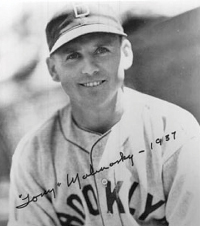
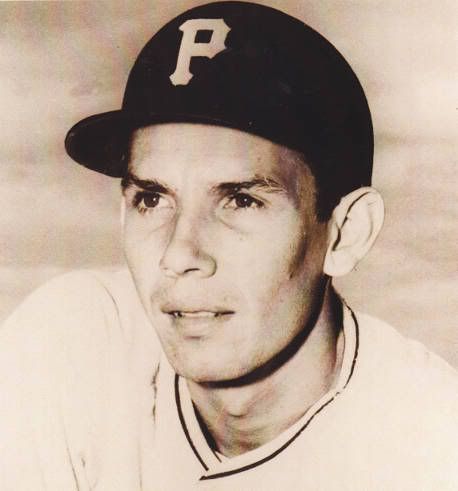
Recent Brooklyn Dodger passings - Tony Malinosky, Gino Cimoli, Cliff Dapper

As we push farther into 2011, the list of living players that appeared in uniform for the Brooklyn Dodgers are dwindling. In the past week, we lost three Dodger alumni: Tony Malinosky, who was the oldest living major league player; Cliff Dapper, the first player to be traded for a broadcaster; and Gino Cimoli, the first batter to appear in a major league game on the West Coast. Click on each of their photos to learn more about each player.

Tony Malinosky

Cliff Dapper
Gino Cimoli


Saturday, February 12, 2011

Tony Malinosky,101, former Brooklyn Dodger passes away

Tony Malinosky, former Brooklyn Dodger passed away last week in Oxnard, CA. He was 101. Malinosky held the distinction of being the oldest living major league player. He played in 35 games for the Brooklyn Dodgers in 1937.

Monday, February 7, 2011

Gonzalo "Cholly" Naranjo Private Signing February 21, 2011

BaseballHappenings.net is proud to present a private signing with legendary Cuban Hall of Fame pitcher and former Pittsburgh Pirate, Gonzalo "Cholly" Naranjo. He currently has a 0% success rate on SCN. All items are due by February 17, 2011.

Cholly was an integral part of the legendary Almendares team from 1952-1961. He was signed by legendary scout "Papa" Joe Cambria to the Washington Senators, and had a catch with President Eisenhower before the home opener in 1954. He was then signed by the Pittsburgh Pirates by Branch Rickey and was a member of the Hollywood Stars of the Pacific Coast League (PCL) before making his debut with the Pirates in 1956 alongside his roommates and future Hall of Famers Bill Mazeroski and Roberto Clemente. He spent most of his life in Cuba, and his autograph has evaded many autograph seekers.

His only standard issued card is the 1957 Topps Pittsburgh Pirates Team Card.

The prices for the signing are as follows:
Cards / Photos / Flats / Index Cards - $10
Your Baseball - $12
Our 8x10 Photos - $15 (includes autograph)
Inscriptions - $5

Shipping costs are as follows:
You can send a SASE with your items, however, you assume all risk for the SASE.

$2 Baseball Cards / Index Cards / Photos Smaller Than 5x7
$4 Photos 5x7 or Larger
$5 Baseballs

If you are located outside of the United States, please email for a shipping quotation.

Payment Forms Accepted:
Paypal / Credit Card
Money Order

Please send your items with a post-it note and name to ensure the correct return.

For details on paying by either Paypal / Credit Card, please send an email to baseballhappenings@yahoo.com

Saturday, February 5, 2011

Andy Pettitte and Whitey Ford: A Comparison

Keith Allison / Flickr / Wikimedia Commons
The big news on the New York baseball airwaves last week was Andy Pettitte's announcement of his retirement after a 16-year career in the major leagues with the New York Yankees and Houston Astros. As soon as the official word was given, a multitude of talking heads discussed Pettitte's candidacy for the Hall of Fame. The soutpaw's career totals parallel that of another Yankee left-handed great, Hall of Famer Whitey Ford.

Below are Pettitte's final totals juxtaposed with Ford's. Playing in the era of specialization, it is no surprise that Pettitte falls short when comparing complete games. The rest of their statistics are eerily similar. How does Pettitte's career stack up against Ford's, and is Andy Pettitte a Hall of Famer? Discuss below.

In case you are wondering, Ford needs a second hand just to display his World Series rings, owning six, while Pettitte garnered five during his career.


Career Statistics
Player Name Stat Type
W
L
ERA
G
GS
CG
SHO
GF
SV
IP
H
R
ER
HR
BB
SO
WP


WHIP
Andy Pettitte MLB
240
138
3.88
489
479
25
4
3
0
3,055
3185
1461
1317
263
962
2251
62


1.36
Whitey Ford MLB
236
106
2.75
498
438
156
45
35
10
3,170
2766
1107
967
228
1086
1956
75


1.22


Wednesday, February 2, 2011

Butch McCord leaves behind a baseball legacy of a lifetime

Baseball lost another great ambassador last week with the passing of Clinton “Butch” McCord. His baseball career spanned from 1948-1961, starting in the Negro Leagues with the Baltimore Elite Giants. reaching as high as Triple-A for four seasons. Let Butch McCord narrate the story of his baseball career, however, he’d reply with a more modest answer.

“I call myself a backup singer,” McCord stated in a 2009 interview. “You know what that is? [You] sing good, but nobody watches you. That's the way I was in baseball. When I was playing, there were only eight teams in each league. It was hard to even get a break.”

For McCord, he almost didn’t even have a chance to play the game that he loved so much. In addition to growing up in the segregated south prior to Jackie Robinson’s signing, neither his high school nor his college, Tennessee State University had a baseball team. It was only through the intervention of one of his football coaches that McCord moved to baseball.

“I was a football player at TSU. I learned baseball from playing in the sandlots. We won the Negro National Championship in 1946. In 1947, Jackie signed and one of our football coaches said, ‘If I were you, I wouldn't play anymore football.’ So I signed with Tom Wilson, who had one of the few black owned ballparks here in Nashville, Wilson Park,” McCord revealed.

Butch McCord - Louisville 1957
Wilson’s untimely death in 1947 put a damper on McCord’s plans to join the Elite Giants. “He asked me to play in 1947, but he died in 1947. His secretary that took over told me to stay and play with the Nashville Cubs. I stayed and played first base for them.”

True to their word, the Elite Giants signed McCord for the 1948 season, but there was a twist. He was going to be playing the outfield, a position he had never played before. McCord described his entry to the legendary ball club. “When I played for Baltimore, they had a first baseman by Johnny Washington, so Henry Kimbro “learned” me how to play the outfield. With them, I played right field.”

In Baltimore, he found himself surrounded by a bevy of talented players, better than any assembly he would play with, including at the Triple-A level in the Dodger organization. “We had such a good team in Baltimore. We had Joe Black, Leon Day, Pee Wee Butts, Henry Kimbro, Junior Gilliam, and Lennie Pearson with us. That was the best team of all the teams I played for,” explained McCord. He probably was right. Day went on to the Hall of Fame, Black and Gilliam were both Rookie of the Year award winners for the Brooklyn Dodgers, and Butts, Kimbro and Pearson were repeat All-Stars in the Negro Leagues.

Like many others who entered the Negro Leagues, McCord experienced baptism by fire during his debut. "My first game in 1948 with Baltimore was against the Homestead Grays. Buck Leonard was at first base, Sam Bankhead was at shortstop, Luke Easter was in the outfield and Luis Marquez was in center field," McCord recalled. "I hit a ball to the left side, a slow ball down the left side. I was a left handed hitter, so I thought, 'I got this one made.' I thought I could run. He [Bankhead] threw me out by about two steps! I said to myself, 'Welcome to the Negro Leagues!'"

If facing the legendary talents of the Negro Leagues wasn't difficult enough, McCord and his teammates endured the Jim Crow laws to persist in playing baseball. McCord told a story when his white teammates with the Chicago American Giants weren't allowed to take the field. "When I was with the Chicago American Giants, we integrated in reverse. One of the white players was Louis Chirban, he was my roommate," remarked McCord. "We go to Birmingham; Willie Mays was still playing with them. Before we got off the bus, the police chief said, 'I hear you have some white players on the team. If you put them in uniform, I will close the concessions and close the ballpark; they'll be no game here tonight.' The white players asked, 'Well can we sit on the bench?' The chief said, 'You have to sit in the stands with the white folks.'" That was the way of life in South. We dodged it a lot of times."

In 1951, McCord signed with the Paris Lakers of the Class-D Mississippi-Ohio Valley League. He feasted on the pitching in the league, batting .363 in 1951 and an astounding .392 in 1952. So beloved was McCord in Paris, that he was honored with a "Clinton McCord Night" that featured Harry Caray who was a young broadcaster for the St. Louis Cardinals at the time.

His fine play saw him promoted to Denver of the Class-A Western League, where he played stellar defense at first base and batted .358 in 1954. One of his teammates in Denver would go on to make the Hall of Fame as a manager, Earl Weaver, who McCord described as a "pepper-pot" and one of the main contributors to their pennant winning season. It was McCord's steady play that would send him off to Triple-A the following season, one step away from the "big show."

McCord would spend the next three seasons (1955-57) at the Triple-A level playing for Richmond, Columbus and Louisville. He posted batting averages above .258 all three seasons and earned a reputation for being one of the top glove men in all of minor league baseball. It was during this time that McCord would reconnect with one of the biggest stars of the Negro Leagues, Satchel Paige.

"The biggest crowd in the minors was the game we played in Miami. There were 55,000 people. It was a benefit game. I got two hits off of him. I got a triple off of him when I was 16. The ones in Miami didn't count; he was an older man then. His main thing was his control by that time."

By 1958, McCord was already 33 years old and fading away from prospect status. That didn't prevent McCord from holding on to his passion. He signed with the Class-A Macon Dodgers, who at the time was managed by Danny Ozark. Ozark would go on to manage many years in the major leagues with the Philadelphia Phillies. When asked about McCord in a 2008 interview I conducted, the late Ozark responded, "I had Butch McCord in Macon. He was a super guy. Good contact hitter, didn't strike out much. He hit over .300. He became the most popular player on the team and the MVP."

McCord would spend a few more seasons in the Dodgers organization, bouncing between Double-A and Triple-A until retiring after the 1961 season with Victoria of the Texas League. He earned two Silver Glove awards for his wizardry around the first base bag. Even until they had to take the uniform off of his back, McCord still thought he had a chance to break through. “I always thought I’d do my best and somebody would give me a chance. Even when I decided to retire, I always thought I was going somewhere.”

McCord returned to Nashville and worked for the United States Postal Service until his retirement in 1988. He remained a fixture in Nashville area baseball, working tirelessly with the Nashville R.B.I. program to promote baseball to the youth in the urban area. He had the baseball field at Tennessee State University named after him following his efforts to revive the program.

McCord wanted to leave me with some advice regarding his longevity. The following words serve as an example of his humor and spirit. "I've been married 58 years to the same woman. I always ask the youngsters, 'Do you know how to be 83 like me? Do you have an idea how you can get there?' Here's the punchline. 'Just don't die.' Going to church, not drinking and all of that is fine, but you can have an accident and die. If you don't die, you might make it!" Don't worry Butch, you made it and in a way much louder than any backup singer could.

More Information -

Clinton "Butch" McCord - The Marsh Collection

McCord recalls his time with the Paris Lakers - Tribune Star

Thursday, January 27, 2011

Barry Larkin leaving the MLB Network?

Baseball barry larkin 2004An anonymous source told us that Barry Larkin will be leaving his post at the MLB Network for ESPN. The 1995 National League MVP was part of the Hot Stove crew that debuted the flagship program for the station in 2009. Larkin made an excellent "double play" combination with Harold Reynolds, often providing excellent insider commentary on the "how-to's" of the game.

Scooter: The Biography of Phil Rizzuto


Carlo DeVito
Triumph Books, 2010 
368 pp.
 
"Holy Cow!" The trademark line from one of New York's most beloved baseball figures resonates vividly in the minds of fans across the country, long after his days in the Yankees broadcast booth. If Phil Rizzuto was still alive, it would be likely that he would exclaim his famous catchphrase after reading Carlo DeVito's “Scooter.”

DeVito provides in-depth detail of the entirety of the Hall of Fame shortstop's life, a career that was almost derailed when Rizzuto dropped out of high school in 1936. Deemed “too small” by the Dodgers and the Giants, Rizzuto was put back on track to embark on what would be a 60-year journey through baseball with the help of his high school coach Al Kunitz and the watchful eye of Yankee scout Paul Krichell.

Signed by the Yankees in 1937, Rizzuto's career was almost over before it started. During his first season in Class-D Bassett, Rizzuto tore a muscle in his leg and was told that his baseball playing days were over. Miraculously, he recovered quickly enough to return that same season and finish with over a .300 batting average. He would go on to hit over .300 at every stop in the minor leagues before debuting with the Yankees in 1941.

DeVito explores the high regard in which Rizzuto's teammates and opponents held his talents. Often overshadowed by the prowess of Yogi Berra, Joe DiMaggio, Whitey Ford, and Mickey Mantle, DeVito illustrates how many in baseball felt it was Rizzuto that was the vital cog in the seven Yankee World Series championship teams he played for. He would stay with the Yankees through the 1956 season, with his career being interrupted from 1943-1945 due to his service in World War II.

The second half of the biography focuses on Rizzuto's storied broadcast career, which endeared him to a whole new generation of fans, many of which only know Rizzuto from his work behind the microphone. Starting in 1957, with the urges of Yankees' sponsor Ballantine Beer, Rizzuto began a 40-year journey in the booth. DeVito expertly chronicles Rizzuto's ups and downs as one of baseball's most recognizable voices and his ever changing partners in the booth.

The final two chapters in “Scooter”, which detail his playing and broadcast careers respectively are over 100 pages each. In these lengthy chapters, the stories switch so much, that it is difficult to find continuity among the tidbits presented. The book would have been better served to be broken into smaller chapters to enhance the flow of information and keep the reader focused on what DeVito is attempting to illuminate.

Small criticisms non-withstanding, “Scooter” is a great look inside the career of one of New York's most cherished and respected homegrown baseball figures, that will please even the “huckleberries” who choose to pick it up.

Wednesday, January 26, 2011

Hank Aaron ushers in Roberto Alomar to the Hall of Fame brotherhood at 2011 BAT Dinner

Roberto Alomar and Gary Thorne listen attentively while Hank Aaron speaks
When the "king" speaks, everyone listens. All ears were on Hank Aaron as he addressed the crowd and the newest member of the Hall of Fame, Roberto Alomar, at the 2011 BAT Dinner last night in New York City. Although Alomar will have to wait until the official ceremonies in the summer to have his day, Aaron gave Alomar a taste of the reception he will be receiving in Cooperstown. Click here to see photos from the event and see video of Aaron giving advice to a receptive Alomar.

Saturday, January 22, 2011

George Crowe, 89, former Negro League player and major league All-Star

George Crowe, former All-Star first baseman for the Cincinnati Reds passed away Tuesday night in Rancho Cordova, Calif. He was 89. 

Crowe was signed by the Boston Braves in 1949 from the Negro Leagues, where he played with the New York Black Yankees. He tore up every classification from a Class-B to Triple-A, posting averages of .354, .353, .339 and .351 between 1949 and 1952 before being called up to the Braves in 1952. Crowe shared time with first baseman Earl Torgeson his rookie year, batting a respectable .258.


During a 2008 interview that I conducted with Crowe, he shared as to why he didn't get more playing time over Torgeson, who batted a lowly .230. 

"When I was in Boston, Earl Torgeson wasn't that great of a player, but he was high on the totem pole of politics," Crowe said. "The manager was his old roommate. Torgeson and Tommy Holmes roomed together for years. Holmes became the manager. Who do you think is going to play?" 

The following season, Crowe was relegated to pinch-hitting duty, as the Braves, who had now moved to Milwaukee, brought in the powerful Joe Adcock to play Crowe's position. Nineteen fifty-four saw Crowe return to Triple-A with the Toledo club. He feasted on the pitching of the American Association, slugging 34 home runs with a .334 average. During that winter, Crowe was a member of the 1954-55 Santurce Crabbers, which many regard as the best winter league team ever. He shared a lineup that included Willie Mays, Roberto Clemente, Don Zimmer, Bob Thurman, Bus Clarkson and pitchers Ruben Gomez and "Sad" Sam Jones. They ran away with the Caribbean Series title that year with Crowe solidifying the lineup at first base.

Crowe's undeniable talent allowed him to wrestle the first base position from Adcock in 1955, where he hit 15 home runs and batted .281. Finally receiving a chance to play regularly, Crowe took advantage of the opportunity and figured to be in Milwaukee's plans as they started to build a World Series contender. A week before the 1956 season opener, Crowe was traded to the Cincinnati Reds for "Hurricane" Bob Hazle, who greatly impacted the Braves' 1957 title run. 

It was with Cincinnati where Crowe, at the age of 36 would have his breakout season. An injury to Ted Kluszewski in 1957 opened the door for Crowe to play full time. Appearing in 133 games, Crowe smashed 31 home runs and drove in 92 runs, placing him 6th and 8th in the National League respectively in both categories.

In the 2008 interview, he discussed the merits of playing full-time. 

"The regular playing time helped," he said. "Wherever I was, I played everyday. It's not the same. There's nothing like playing everyday. If you can get in there once every two weeks, you might have a good day, but it's another week or ten days before you play again. It's hard to keep a sharp edge."

Sadly, he was the only Cincinnati Reds player not selected to the All-Star game as part of the infamous ballot stuffing scandal. He was beat out by the legendary Stan Musial. He would receive a degree of retribution the following season when he was selected as a reserve to the 1958 All-Star team after batting over .300 the first half of the season.  

Crowe played until 1961, finishing his career with the St. Louis Cardinals. He served as a mentor to younger African-American players such as Bob Gibson and Bill White. At the time of his retirement, he held the MLB record with 14 pinch-hit home runs. 

In addition to his lengthy major league baseball career, Crowe was a standout basketball player. He was the first Indiana Mr. Basketball award winner in 1939. He played professionally for the Harlem based New York Rens and the Los Angeles Red Devils, the latter of which included Jackie Robinson. Crowe remembered Robinson as, "a good basketball player."  

Crowe lived in the Adirondacks until five years ago when he moved to California to be closer to his family. After suffering a stroke in late 2008, Crowe resided in an assisted living facility until his death earlier this week.


Friday, January 21, 2011

Willie Mays shows Harlem children greatness at Public School 46 appearance

Earlier Friday, Hall of Fame baseball player Willie Mays returned to the Polo Grounds, the site of his first major league assignment. The memories of Mays darting across the depths of the outfield in Harlem remain vivid in the minds of those who witnessed it; however, some 60 years later, the Polo Grounds have changed, with buildings marking where the historic ballpark once stood. Situated across the street from the site of the former baseball cathedral is Public School 46. The youngsters there received the treat of a lifetime, as the iconic Giants great visited the school with the 2010 World Series trophy.

Willie Mays outside PS 46 / N. Diunte
Mays addressed a full house of over 300 students, staff and parents at the Harlem school. Hanging on his every word, the crowd listened attentively as he regaled the crowd with tales of children bellowing at his window in the morning to play stickball with them in the same city streets where they currently reside. Returning to the area where he built his legend motivated him to address the children.

"[In] 1951, when I first started, I lived right on top of the hill here," Mays said. "I used to go up and down this street all the time so I'm familiar with this area. That's why I wanted to come back and let all of the youngsters know what I was doing here."

He advised the children to further their education and support their families.

"Education is the key to this lifestyle now," Mays said. "You have to get an education ... go as far as you can."

During the ceremony Mays gave out 12 autographed baseballs to "A" students. When he got to the 12th student, he was out of baseballs. Mays, being the entrepreneur that he is, reached into his pocket and gave the child a crisp $100 bill. During the assembly, he fielded questions from the students who had researched his career before his appearance. One of the things he discussed was his fondness for the "Big Apple".

"I don't think I ever left," he said. "I didn't go to San Francisco by choice, I was asked to go by the team. New York has always been part of my home."

Monday, January 17, 2011

Roy Hartsfield, 85, first manager of the Toronto Blue Jays, 1925-2011

Roy Hartsfield, the first manager of the Toronto Blue Jays and former second baseman for the Boston Braves passed away January 15, 2011 in Ball Ground, GA. He was 85.

Hartsfield played second base for the Braves from 1950-52 while maintaining a .273 batting average. He was traded after the 1952 season to the Brooklyn Dodgers for Andy Pafko. He would not return to the major leagues as a player after the trade.

The rugged second sacker entered organized baseball in 1943, playing for the Atlanta Crackers before entering World War II. Hartsfield served in the Navy at the famed Great Lakes Naval Base. In a 2008 interview with Hartsfield, he described the baseball legends that awaited him at Great Lakes.

"I played my first year in the Navy," he said. "I was the only minor league player on the ball club. All of the others were major leaguers. We had Virgil Trucks, Schoolboy Rowe, Clyde McCullough, and Billy Herman. We played a 50 game schedule, we won 48 and lost 2; I guess we did pretty good. Billy [Herman] helped me quite a bit with my fielding ability. He treated me very good. In fact, they all treated me like I was their son because I was so much younger than them. I was only 18 years old!"

After a year, he was sent out to finish his service. He detailed his service upon leaving the Naval Base.

"I spent 10 months riding a banana boat between Mobile, AL and Central America (Honduras and Guatemala). I was riding that boat when the war was over."

After returning from his military service, he floated between Single-A and Double-A before catching a big break in 1949. He was signed by Braves organization from Dallas in the Texas League that year and had a standout season at their Triple-A affiliate in Milwaukee.

"It was a little tougher, but probably that year, I had the best year in my life," Hartsfield said.

That career year catapulted him to the major leagues the following spring.

Hartsfield was the regular second baseman for the Boston Braves in 1950 and 1951. Looking at Hartsfield's stats, one might wonder how a second baseman who hit .273 suddenly disappeared from the majors without a downturn in performance. Hartsfield revealed why he didn't have a longer career with the Braves.
"I had a severe case of heat exhaustion before I went to the big leagues. I played in a double header in Savannah, GA and I became completely dehydrated. I didn't realize what was happening to me. Nothing like that had happened to me ever before. They took me to the hospital like it was all over. The second game of a doubleheader was when it hit me, got cramps like football players. The doctor told my wife, 'He'll never be the same in the heat anymore.' And he was absolutely right. I couldn't play doubleheaders. I played as long as I could but then I had to walk off the field. I realized at the same time, I was losing the job. They didn't pay two salaries for one job in those days. I have nothing against the Braves, they did everything they could to help me, sent me to every doctor you could think of. That was the reason. I have a lot of people ask me to this day why I didn't play longer. They didn't know that because I didn't tell anyone that. It didn't come out until later on."

Hartsfield would not return to the majors after being traded to the Dodgers, spending five seasons at the Triple-A level, including one as a player-manager before managing full time in 1958. He saw the writing on the wall after being traded away from Boston.

"When I was traded from the Braves to the Dodgers, I knew I wasn't going to go back to the big leagues as a player because of my reputation of not being able to play in the heat," he said. "I knew that. I told my wife, 'If we're going to stay in this game we've got to go in another direction instead of playing.'"

Luckily for Hartsfield, the Dodgers opened the door to managing that would make him part of the family.

"They gave me my first managerial job," he said. "I was very appreciative of that. They treated me very very well. I was fortunate in that the Dodgers gave me a job managing to begin with. In those days, they had started losing teams every year. The first year I managed was Class-A ball in Des Moines. I was told by Fresco Thompson that he couldn't promise me anything past the first year, because they were losing clubs. They not only lost the team, the whole league folded up."

For a 32-year-old, the prospect of being unemployed after spending their whole career in professional baseball was daunting. Hartsfield described how Fresco Thompson saved his career.

"Here I am sitting in November without a job after my first year. My phone rang and it was Fresco. He said because of leagues folding, the only opening was in Class-D ball."

Faced with the choice of a demotion or not knowing where the next check was going to come from, the choice was simplified for Hartsfield.

"I realize there is more prestige in managing Class-A ball then Class-D ball, however, I told him, 'I've yet to go to the grocery store and buy any groceries with prestige, so just run it on out here and work.' I did that two times for him. I stepped down twice. He told me I would be considered if anything opened above. I moved every year until I got the top job, managing  Spokane for three years before I got a job with the big club."

True to his word, Thompson moved Hartsfield up the ladder where he joined the Los Angeles Dodgers as coach from 1969-1972.

In 1977, he was named the manager of the expansion Toronto Blue Jays during their inaugural season. The Jays struggled with young talent as they matured at the major league level. Hartsfield knew that he would have to build from within as the other teams weren't going to make their top-level talent available in the expansion draft.

"We developed our own because nobody was going to give you anything in this racket," he said. "We agreed to have the right type of veterans mentally that would fit into our scheme of things."

While managing the Blue Jays, Hartsfield had a lanky rookie that would go on to have an All-Star career, albeit in another sport, basketball. Danny Ainge was a 20-year-old rookie out of Brigham Young University when he showed up for the Jays in 1979. Hartsfield had experience playing with another dual sports star, sharing the field with Hall of Famer Bill Sharman in St. Paul. Hartsfield related the situations of both Sharman and Ainge, as both chose basketball as their main careers.

"Sharman was a pretty good player on the Triple-A level," he recalled. "At the time, I wasn't judging Bill because he was a good teammate and friend. He made the right decision [with basketball], same as Danny Ainge, who played for me in Toronto. When you have an expansion ball club, you don't have full fledged major leaguers at every position. Bobby Doerr was my hitting coach and he was the one who signed Danny. He told me when he signed that his sport was basketball. Bobby was right. Ainge was a fierce competitor. He could have used a few years on the minor league level that he did not have. Who knows, maybe it would have helped, maybe it wouldn't?"

After being replaced as the Blue Jays manager to start the 1980 season, Hartsfield cited family responsibilities as the reason he retired after a short stint thereafter as a minor league manager. 

"I left Toronto and managed a few years in the minors," he said. "I was vested in the pension plan. I had 10 years on the major league level, so I didn't want to just manage for the sake of managing anywhere they offered me a job. I had a family that I didn't get to spend too much time with, so that determined my quitting."

In retirement, Hartsfield didn't follow baseball as closely as he did when he was playing and managing. He would visit the Braves annually, where for a day; he was back in the spotlight.

"Bobby Cox is a close personal friend of mine. The Braves invite me every year for an autograph session one night. They treat me royally and I get to visit with Bobby a little bit."

Somewhere in Heaven, the red carpet has been rolled out and the spotlight again is on Roy Hartsfield. 


Martin Luther King said Don Newcombe helped to ease his path to lead the civil rights movement

Don Newcombe 1956 Topps
As we celebrate the memory of Dr. Martin Luther King Jr. today, take a look at this piece documenting the historic relationship between Brooklyn Dodger hurler Don Newcombe and the legendary civil rights leader. King paid Newcombe the highest tribute only a month shy of his tragic demise.

Saturday, January 8, 2011

Ryne Duren's impact was a lot stronger than his 100 MPH fastball

Famous for his Coke-bottle glasses and his blazing fastball, Ryne Duren was an integral part of the 1958 World Series champion New York Yankees and a three-time All-Star. He passed away Thursday at his home in Lake Wales, Florida at the age of 81.

Ryne Duren / Author's Collection
Duren was signed by the St. Louis Browns in 1949 and made his debut as a September call-up in 1954 when the franchise moved to Baltimore. He spent the next two seasons in the minor leagues perfecting his repertoire. It is during that time in the Pacific Coast League with Vancouver where Duren's legend grew. Hollywood Stars and future Pittsburgh Pirates hurler Cholly Naranjo remembered the reluctance his teammates showed to face Duren on a bitterly cold Opening Day in 1956.

"In 1956 we had opening day up in Vancouver and it was cold man," Naranjo recalled. "Duren was the starting pitcher. The guys from our ball club didn't even want to go up to hit. That son of a gun used to throw so hard with those thick glasses. Everybody got back in the clubhouse to get close to the heaters, nobody wanted to go to hit."

Stories have been told of Duren being so wild that he threw warmup pitches off of the backstop. Others thought it was to make sure batters never got a strong toehold in the box. Johnny Romano, who later became an All-Star for the Cleveland Indians, was Duren's catcher in Vancouver. He felt that Duren knew exactly what he was doing with his occasional spells of wildness. Romano told how Duren silenced the Pacific Coast League's top power hitter Steve Bilko with a temporary loss of control.

"I just came from Double-A and went up to Vancouver. I never caught a guy that could throw so hard at that particular time," Romano recalled. "I remember that season the home run king was Steve Bilko. Steve was hitting the ball constantly against us when we played in Vancouver. He came up this one time while Duren was pitching. When he faced Ryne, he was standing back one-and-a-half to two feet from the plate because he was afraid he was going to get hit. The way he was hitting, he was probably going to go down. The first pitch pushed him back off the plate and after the third pitch, he must have been back three feet from the plate. He didn't want nothing to do with Ryne. Then Ryne threw three strikes down the middle. Steve didn't flinch. They couldn't say he was wild. He was known to be a wild pitcher, but he wasn't wild if he could throw three straight down the middle."

In 2003, Duren along with the president of the non-profit organization Winning Beyond Winning, Tom Sabellico, authored, "I Can See Clearly Now" a memoir about his baseball career, struggles with alcoholism, and life after baseball. Sabellico established an enduring relationship with Duren that went far beyond baseball.

"I met Ryne about 13 years ago and he was as big in person as I remember him as a kid, watching him hop over that bullpen fence," Sabellico said. "He had the attitude that he could get the job done. He became a big speaker for Winning Beyond Winning. His life experiences, his openness, his willingness to share with kids and any youth group was just extraordinary."

Sabellico discovered the power that Duren's story had on the fans he met while traveling with him. He found that Duren left an indelible mark on those he encountered.

"After we wrote the book, he used it as a tool in his speaking with groups," he said. "When we went on these tours and met people, I'll never forget the faces of these people and the expressions when they thanked him for having either saved their lives or their loved ones. It was extraordinary how many people knew his story no matter where we went, whether it be Wisconsin, Florida, or Pennsylvania. The people, as soon as they would see him, would thank him. Whether through his clinic in Wisconsin or his talks, one day at a time, he helped to save them."

Duren had urged Sabellico to help him with the book because of how proud he was of what he did after his struggles with alcoholism. Sabellico discussed Duren's impetus for writing his second work.

"He became much prouder later in life," he said. "That's why he wanted the book written of what he accomplished off the field rather than on the field because he felt that he screwed up a bit with the alcoholism when he was on the field and he could have been so much better. He was given a second chance and was able to accomplish much more. His first memoir, "The Comeback," Robert Drury wrote in 1978 and he felt he had accomplished a lot since that time. He wanted me to get that out, not only to retell his story but to add what happened since the first book. He told me, 'I like the way you write, I want to give you the opportunity to rewrite this story.' I spent a lot of time with him in Florida and researched it. What he really wanted to get out was, not just the baseball part of it, but the education part of it. He wasn't anti-alcohol, he was pro-education; he wanted people to understand what it was about and how it affected them. You not only needed to treat the person but the people around the person so they would understand the addiction."

Duren's passing left Sabellico with unforgettable memories of a man who turned his life around to help others. He touched the author in the same way he did those who struggled with substance abuse.

"He was a powerful no-nonsense guy," Sabellico said. "He had been to the bottom. He tried to commit suicide a few times and when he spoke about it, he was serious and could affect people's lives. I'll tell you my life was affected by him; I'll never forget him."

Saturday, January 1, 2011

A tribute to the major league baseball players who died in 2010

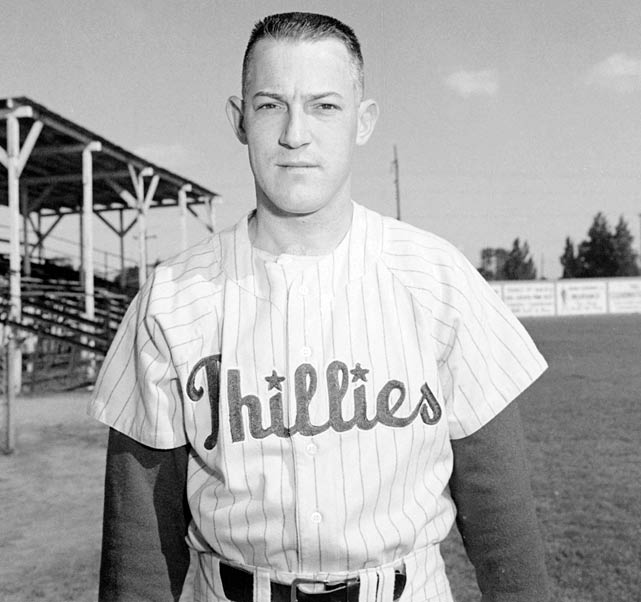
Sparky Anderson
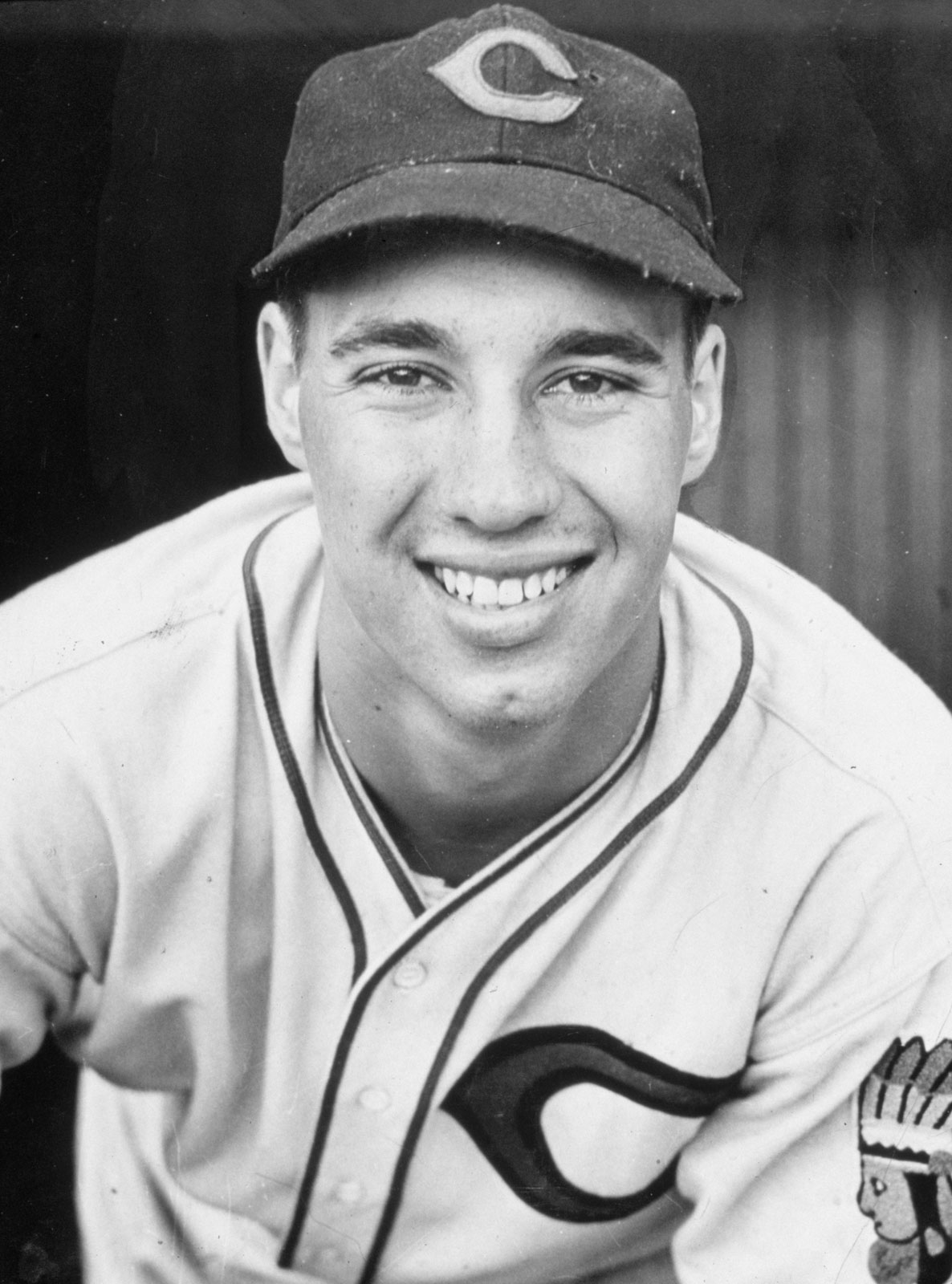
Bob Feller
Robin Roberts
With 2010 in the rear view mirror, let's stop and reflect on the deaths of the members of the major league baseball family, which included three Hall of Famers, Sparky Anderson, Bob Feller and Robin Roberts. Click here to see a more in-depth profile of those that we lost this past year.