Saturday, October 20, 2012

Steve Springer preaches quality at-bats in his new journey

For Steve Springer, baseball has always been an issue of quality over quantity. Springer tried to make the most of his 17 major league at-bats with the Cleveland Indians and the New York Mets, and is now working with young players helping them to do the same.

“If you know my story, I didn’t start in high school, I got three at-bats as a freshman in high school, and three my freshman year in college. I go around the country inspiring kids not to quit,” Springer said via telephone from his home in California.

Steve Springer - Checkoutmycards.com

Springer has carried the message through his CD / DVD combo entitled, “Quality At-Bats,” where he breaks down the mental side of hitting into something easily digestible, all to develop confidence in players at all levels. The New York Times featured Springer earlier this year when New York Yankees top prospect Dante Bichette Jr., said that he listens to Springer’s CD every day on his way to practice and games. Major league superstars Jose Bautista and Mark Trumbo are among the many who also praise Springer’s message.

“I made this CD about 12 years ago, and I almost feel God put me in AAA for 11 years to do what I’m doing now to try to help kids. Right now, I’m the mental coach for the Toronto Blue Jays, but I have big leaguers on other teams call me because they had the CD in high school or college.”

How exactly is Springer going about changing the game with his program? It’s a paradigm shift aimed at removing the emphasis from one’s batting average, something he claims has destroyed more players’ dreams than the first time they saw a good curveball.

“The batting average is the most evil thing in baseball; it destroys more young players than anything in the game. I did everything right but went 0-4. Why is that number so powerful?” Springer asked.

“I’m trying to change what these kids think success is so they can walk up to the plate with confidence. We all have two different players in us, confident guy and we have the non-confident guy. The confident guy is a good player, and the non-confident guy isn’t. How do we get the confident guy to come out? That’s how I’m having success with some of these guys, by setting daily attainable goals: I hit the ball hard, I win; team first, etc.”

Getting players to stay in the game mentally is tough, but it is something that he preaches to his students if they want to be able to put their best foot forward every time they step on the field.

“I know batting average will not go away. I’m trying to get them to be the best competitor by walking on the field with confidence,” he said. “They have the tools, and I ask them if they want to be the best player on the field today. I say to them, ‘Be the best competitor, and you’ll have a chance.’”

So how did Springer, who toiled in the minor leagues for 14 seasons, save for two cups of coffee in 1990 and 1992, keep his edge?

“I always felt that I was good enough if given the opportunity,” he said. “I knew the alternative of getting a real job and I didn’t want to do that,” he said. “I got good when I got too old. I was the MVP of my AAA team the last 4-to-6 years [of my career], but I couldn’t get a call-up.”

Springer spent most of his career in the Mets organization, starting in 1982, the same year as Dwight Gooden.

“I signed with Dwight Gooden, he was a first rounder, and I was a 20th,” he said. “He was a great teammate and a great guy; I loved him, he was awesome. I was in Little Falls and he came up the last three weeks of the season, and I was in awe watching him pitch. He could have pitched in the big leagues right out of high school; he was that good. He was athletic; he had a big arm, good curveball, and command. I didn’t doubt in my mind that there were 300 pitchers in the big leagues better than him.”

The second baseman began to hit his stride right in between the Mets two playoff runs in 1986 and 1988. Looming behind mainstays Wally Backman and Tim Teufel, there was little room for Springer to break through.

“I thought I had more of a chance in 1987, I was in the top 10 in the league in hitting, but when Howard Johnson went down, they called up Keith Miller,” he said.

Springer plugged away despite being overlooked, to the tune of almost 1,600 minor league hits.

“The whole Met era in the 1980’s was awesome. If I was with another organization, I probably would’ve got up quicker. You couldn’t tell me I couldn’t spend five years in the big leagues.”

The Mets traded Springer away from the organization in 1988 but returned in 1992 after a brief call-up with the Indians in 1990. This time the Mets rewarded Springer for his perseverance.

“[It seemed like] twenty guys got hurt. Willie Randolph got hurt, and I get called up for 10 days, I go 2-for-3 with a double in ‘Frisco, and I’m thinking, ‘Sweet!’ I got sent down before I put my hat in my locker. They tell me they’re going to call me up in five days,” he recalled.

Somehow, fate was not too kind to Springer, who waited 11 seasons to get his shot in a Mets uniform. After a strong finish in AAA Tidewater, Springer hung around for the call. It never came.

“I hit .290, got the Doubleday award [for] MVP of the AAA team, and then two days later, they trade David Cone to Toronto for Ryan Thompson, and some stiff named Jeff Kent. So I’m out, [because] they needed my roster spot,” explained Springer.

He spent another three seasons in the minor leagues, retiring after the 1995 season. At least his brief journey with the team that drafted him ended on a high note.

“I feel blessed I got called to the big leagues. The last time I stepped in a major league batter’s box, I got a hit!”

Springer’s career turned to scouting at the urging a close friend who was working with the Diamondbacks when he was contemplating if he should play one more year.

“Luis Medina called me and said, ‘Your playing career is killing your scouting career. Then 30 minutes later, the Tigers called me up and offered me $5,000 per month and no big league camp. The previous year I was making $7,000, so I called Luis back up and he put my name in with the Diamondbacks and I went right in with them,” he said.

He scouted for five years before becoming an agent for the next seven. He returned to the Diamondbacks in 2008 as a scout before the Blue Jays called.

“The Blue Jays came and got me because of my CD really, and wanted me working with all of their kids.”

When he is not working for the Blue Jays, he travels the country giving what he calls, “The Mental Hitting Lesson.” The positive effects that he has seen from his CDs, talks, and seminars continue to drive him.

“This needs to be a confident, fun atmosphere at a young age, and I don’t think it is,” he said. “I get chilling e-mails from kids and parents thanking me for making this CD, telling me how it changed their life. It’s mind-blowing.”

For more information on Springer’s “Quality At-Bats,” CD’s and DVD’s, visit – www.qualityatbats.com

Sunday, October 14, 2012

Darryl Strawberry's restaurant in Douglaston to close

In Douglaston, N.Y., the straw will no longer stir the drink. Strawberry's Sports Grill, which bears the name of the former Mets and Yankees slugger Darryl Strawberry, will unexpectedly shut down this Sunday evening. The news came as a complete surprise to the staff.

“It came out of nowhere,” said Michael Strawberry, Darryl’s older brother, to the Queens Courier.

The elder Strawberry who was involved in the restaurant's operations, did not have a say in the decisions that led to its demise.

"I am very sad," he said. "Rest assured it had nothing to do with my brother and me."

The restaurant opened in August, 2010, with much fanfare, attracting celebrities such as Justin Timberlake, Miss USA Rima Fakih, as well as Yankee baseball legends Whitey Ford, and Bernie Williams. Packed crowds ensued for the following year, some hoping to catch a meeting with Darryl in-person, others to take in the great food and spirits while watching a variety of sporting events.

Darryl Strawberry interviewed at the opening of his restaurant / N. Diunte
Strawberry's continued to build its affinity through a strong presence in social media, as well as holding many baseball-themed events. Their wildly successful Community Day that featured appearances by Strawberry's former teammates Kevin Mitchell, Terry Leach, and Barry Lyons, as well as a well-attended 25th-anniversary reunion for the 1986 Mets later that fall made Strawberry's Restaurant feel like it would be in the community for years to come.

As the establishment attempted to move past its honeymoon phase, 2012 was weathered by instability; a seemingly endless rotation of managers, changes to the sports-themed staff uniforms, and an overhaul of their menu that disenchanted the loyal customer base they initially attracted.

"They had the neighborhood crowd in their back pocket and lost it," said Darrin Meenan, the owner of the The 7 Line, who was a frequent collaborator with the restaurant.

Thursday, October 11, 2012

1986 World Series hero Howard Johnson brings excitement to the 2012 Harrison Apar Field of Dreams Golf Classic

Howard Johnson’s sweet swing was on display once again Monday afternoon, but it was not the one that often filled outfield seats at Shea Stadium, but a smooth touch that lit up Mohansic Golf Course at the 2012 Harrison Apar Columbus Day Golf Classic.

Howard Johnson (c.) led a group of ex-MLB players at the Harrison Apar Golf Classic
Johnson was part of a handful of retired major leaguers that also included New York Yankees All-Star pitcher Tommy John, George Alusik, Dave Lemanczyk, Don DeMola, Matt Merullo, and Rick Surhoff, all who played in support of the Harrison Apar Field of Dreams Foundation.

Wednesday, October 3, 2012

Hall of Famer Mike Schmidt once again speaks out about autographs

Mike Schmidt signed card - Baseball Almanac
Hall of Famer Mike Schmidt is back again, complaining about autographs, this time about the awful scrawl of modern athletes. In 2010, we spotlighted a Sports Illustrated article by Schmidt entitled, "The autograph craze is out of whack," where Schmidt takes to task all of those who try to get his autograph in public for free by covert methods.

Schmidt has followed that up with, "Perfect penmanship becoming a thing of the past with autographs," where he calls out modern players for having illegible autographs, and again takes the time to go after collectors who try to get players outside team hotels and other places they frequent. This is coming from someone who purposely signs in a much sloppier fashion the rare times he signs for free in public, to make sure he protects the value of his autograph. One can understand that as a Hall of  Famer, a big asset is your signature, but when you are getting paid tens of thousands of dollars per public appearance, do you really care if a few people somewhere down the line make a few bucks from your signature because they couldn't afford the $75 the promoter is asking at a show?

The quality of modern autographs have seriously deteriorated, as players try to meet the increased demand at games, spring training, etc., but yet a few great examples remain, such as those of Michael Cuddyer, Huston Street, and Pat Neshek. If Schmidt is so concerned about the quality of current signatures, he should take a few players under his wing, just as the late Hall of Famer Harmon Killebrew did with Cuddyer, and fellow Hall of Famer Tommy Lasorda did with Street. A word from this Hall of Famer might just carry enough weight to make a difference.

Former Yankee All-Stars Come Together To Help The Jason Krause Kick Cancer Scholarship Fund

Graig Nettles (far left), Darryl Strawberry (c.) and Mickey Rivers (r.) with the volunteer staff.

New York baseball legends Dwight Gooden, Graig Nettles, Mickey Rivers, and Darryl Strawberry were all on hand this Saturday to help benefit the Jason Krause Kick Cancer Scholarship Fund at Kennelly’s Grille House in Congers, N.Y. The benefit, which is now in its third year, had a record turnout this weekend, due in part to the generosity of the aforementioned superstars.

The fund was launched in memory of Krause, who was a star soccer player at Clarkstown North High School who succumbed to brain cancer at the age of 33 in 2008. The grassroots support was overwhelming, with close to 300 people turning out in the small town of 8,500. A tremendous array of prizes was raffled off for supporters including a trip to the, "Big Game in New Orleans in February" and a complete run of playoff tickets for the New York Yankees. All proceeds went to fund a soccer scholarship for a Clarkstown North soccer player in Krause’s honor, as well as the “Jason K: A Matter of Hope Fund” at Memorial Sloan-Kettering Cancer Center.

The baseball legends spiced up the event, fortuitously signing autographs and taking photos with a seemingly never ending line of requests. Strawberry, a cancer survivor himself, was more than proud to oblige.

“Any event where I can give back, and raise awareness, I’m glad to do it,” Strawberry said. 

Gooden, a hero for both the Mets and Yankees, relished the memory of another brain cancer victim, his former battery mate, Gary Carter. 

“My best memory of Gary Carter was in the 1984 All-Star Game,” Gooden said. “I struck out three batters in a row, and on our way back to the dugout he said, ‘Wouldn’t this be nice to do every fifth day?’ Little did I know that he would be with us next year.” 

For more information on the Jason Krause Kick Cancer Scholarship Fund, visit - http://www.facebook.com/JasonKrauseKickCancerScholarship


Sunday, September 30, 2012

Frank Saucier's promising career derailed by more than Veeck's midget intervention

Frank Saucier once batted an astonishing .446 in 1949 while playing with the Wichita Falls team of the Big State League; a total that to this day stands as one of the highest ever for a single professional season. Yet over 60 years later, Saucier’s claim to fame is not his towering feats at the plate, rather it is the distinction of being the only player in Major League Baseball’s history to be replaced by a midget.

On August 19, 1951, Saucier returned from right field to the bench of the St. Louis Browns at the bottom of the first inning after helping to hold the Detroit Tigers to a scoreless first frame. The events that transpired after Saucier went to grab a bat from the rack to face Tigers’ hurler Bob Cain permanently engrained Saucier’s name in the depths of baseball’s annals.
Frank Saucier Portrait / N. Diunte
Before revealing the details of Saucier’s historical moment, let’s go back a few months to the beginning of the 1951 season. He began the season on the suspended list when he held out for a bonus and refused to sign his contract. Saucier turned his attention to managing oil fields in Okmulgee, Okla., content with the money he was making away from baseball. With the season marching along and no attempt from management to make amends on his contract demands, Saucier donning a major league uniform in 1951 seemed almost as absurd as a midget taking the field. The thought of either happening at the time might have been a foregone conclusion, unless your name was Bill Veeck.

Veeck led a group of investors that bought the Browns midway through the 1951 season, and one of the first moves he made was to personally visit Saucier to persuade him to join the club. After an hour of discussions, Saucier penned his name on a major league contract worth $10,000. Veeck hoped that the popular Saucier would energize the fan base and get the turnstiles moving. Slightly over two weeks after he was signed, Saucier made his major league debut on July 22, 1951. Rusty after taking a three month break from playing, Saucier developed bloody blisters on his hands that made it hard for him to swing a bat, and acute bursitis that made it hard for him to throw. The World War II veteran soldiered on for the rest of the season, with most of his appearances coming as a pinch runner. So why was Saucier in the lineup on July 19th?

A week prior to the game, Veeck alerted the newspapers in Saucier's hometown of Washington, Mo., that he would be playing. The news of his appearance brought a few extra thousand people to the game, something the Browns desperately needed. Saucier hoped Cain didn’t have his best stuff that day because he was in no shape to take a hack.

"I go over to the bat rack and pick up my Louisville Slugger, model K44, and I step up to the plate. And I hope (Tigers pitcher) Bob Cain walks me because I sure can't swing the bat," Saucier said to ESPN.com.

He didn’t even get the opportunity to dig his cleats in the batter’s box when his at-bat was interrupted by a stark announcement that boomed across the stadium.

"When the announcer called Eddie, I was thinking this is both the greatest act of show business I've ever seen, plus it's the easiest money I've ever made," Saucier said.

Three-foot-seven-inch midget Eddie Gaedel waddled up to the plate, and true to Saucier’s hopes, Cain couldn’t find the plate. Thoroughly distracted by Gaedel’s miniscule strike zone, he walked him on four pitches. After a few waves to the crowd, Gaedel eventually made it to first base and was replaced by Jim Delsing. Gaedel walked off the field, never to be heard from again by his baseball teammates. He died at 36 in 1961 after suffering a heart attack.

As for Saucier, he finished the season with a .073 average (1-14); limited by the nagging injuries that plagued him all season. He was recalled to active duty by the United States Navy in April, 1952 to serve in the Korean War. Four years after starting his baseball career, it was over. He spent two years in the service, receiving his release from active duty in April, 1954. He returned to the oil business, and then became a financial consultant in Amarillo, Texas before his retirement. The baseball fields at his alma mater, Westminster College are named in his honor. At the age of 86, Saucier is living in Amarillo, the last living player from the St. Louis Browns that participated in the July 19th affair. Saucier has embraced his role in baseball history, generously sending out numerous articles about his career after recent correspondence with him via mail (pictured below).

A tip of the cap goes to Bob Lemke's article, Frank Saucier's brief but memorable career now commemorated, which provided valuable background information for this piece.


Frank Saucier Autographed Photo and Card / N. Diunte


Monday, September 24, 2012

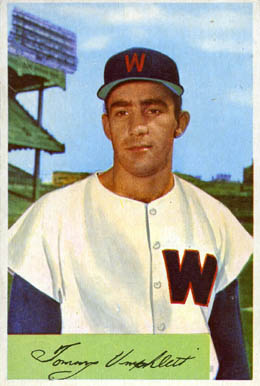
Tom Umphlett | Former outfielder for the Boston Red Sox and Washington Senators dies at 81

Tom Umphlett, former outfielder for the Boston Red Sox and Washington Senators died Friday, September 21st, 2012 in Norfolk, Virginia. He was 81.


Part of the Boston Red Sox 1950s youth movement

Umphlett played three seasons in the major leagues from 1953-55, finishing second in the 1953 American League Rookie of the Year voting to Harvey Kuenn. He was part of the Red Sox youth movement in the early 1950s to fill the voids left by Ted Williams’ military service and Dom DiMaggio’s retirement.

“[Lou] Boudreau, the manager, was going for the young talent even in spring training," he said during a 2008 interview from his home in Ahoskie, North Carolina. “You had Ted Lepcio at third base, Milt Bolling at short, Goodman at second, and Dick Gernert at first base. I played center field, and Jimmy Piersall played right.”

Ted Williams memories

Ted Williams returning from the Korean War meant that someone had to go from the crowded outfield, and the Red Sox looked to capitalize on Umphlett’s value after his impressive rookie season.

“You didn’t have a choice, back in those days,” he said. “When a club owned you, they owned you. I was in the Mickey McDermott for Jackie Jensen trade. [It was] probably one of the best trades the Red Sox ever made. The Red Sox needed a power hitter, and Jensen did a good job for them.”

Despite only spending one season with Williams, Umphlett didn’t hesitate to identify the Hall of Famer as the best in the business.

“I’m gonna tell you just how I feel," he said. "When he came out of the service, everybody was excited. I know I was!

"I was a raw rookie. I got the opportunity to play with the world’s greatest hitter, and not everybody can say that. I saw a lot of good hitters, but as far as I was concerned, he was the best. You can talk about Mantle, Mays, Aaron; they’re all great hitters, great players, but Williams was the greatest hitter I’ve ever seen.”

A Move to Washington D.C.

Umphlett played two years with the Senators from 1954-55. After batting .283 his rookie year, Washington had high hopes for him to duplicate his Boston success. Umphlett hit a sophomore slump, batting only .219 in 1954 and .215 in 1955. Even though he would never return to the majors after 1955, this wasn’t the end of the road for Umphlett. He played in the minor leagues, mostly at the Triple-A level until 1967, when he finally hung up his cleats after 17 seasons in professional baseball.

He reluctantly traded in his glove for the managerial reins, spending an additional four years coaching in the Minnesota Twins minor league system.

“I spent 21 years in baseball,” he said. “I didn’t want to manage at first. I managed in the rookie league [in 1967], and we won the pennant. Then I managed a couple of years after that, and that was it for me in baseball.”

Honored to be a major leaguer

Even though he only lasted three seasons in the major leagues, Umphlett was honored that he made it to big leagues when there were only 16 teams.

“I was a good center fielder,” he said. “I could catch the ball and throw it. I’m not bragging, but I could play center field with anybody. It was tough to get to the big leagues because we only had 16 teams. When you went to spring training, you never had seen so many ballplayers in your life.

"There were some pretty good ballplayers, some that never got the opportunity to get to the big leagues that could have probably played there. You take a guy that probably played behind a guy like Mantle, what chance does he have to get there? He has to go to another club or change his position. I got there, and I made it. I worked hard, and I was fortunate to be there.”

Sunday, September 23, 2012

Dwight Gooden to appear at Greenwich Citibank on Tuesday, September 25, 2012

Dwight Gooden / N. Diunte
Dwight “Doc” Gooden, a 2010 inductee into the New York Mets Hall of Fame and member of the of the New York Mets Alumni Association Presented by Citi, will be greeting fans and signing autographs from 12:00-1:30 pm on Tuesday, September 25th at the Citibank branch at 16-18 Railroad Avenue in Greenwich, Ct., in support of Citi Tuesdays.

Gooden was the 1984 National League Rookie of the Year, the 1985 National League Cy Young Award winner, and part of the Mets 1986 World Series championship team. He is ranks in the top 3 on the Mets all-time list in various pitching categories, including games won, strikeouts, inning pitched, won-loss percentage, and complete games.

Citi Tuesdays is a program designed to provide added value to Citi customers and Mets fans. For more information and details on all Citi Tuesday offers, please log on to www.Mets.com/CitiTuesdays or visit the Citi Tuesday information booth located by the Shea Bridge at Citi Field on every Citi Tuesday.

Tuesday, September 18, 2012

Why Mookie Wilson is forever endeared to Shea Stadium

For Mookie Wilson, he will always find comfort in the confines of Shea Stadium. For 10 years, Wilson was a fixture in center field, tracking down balls far and wide to the delight of the New York Mets faithful. It is no surprise that despite spending time as a coach for the Mets in their new digs at Citi Field, he remains loyal to its predecessor.

Mookie Wilson at Citi Tuesdays - N. Diunte
“It’s interesting that you use the word home because that’s what Shea was," Wilson said while making an appearance Tuesday afternoon as part of the Mets Citi Tuesdays promotion at Citibank in Lower Manhattan. "To me, Shea was home. Don’t get me wrong, Citi Field is a beautiful ballpark; I think that it is fan friendly. I would have loved played at Citi Field, but you can’t replace Shea. That was home for us. It was old, [and] yes, it needed repairs, but it was home and we loved and enjoyed playing there. I don’t think you can compare the two. Shea has its history and Citi Field is in the process of making its own history and it’s going to take time.”

The 56-year-old Wilson, while no longer part of the coaching staff remains on the books as an ambassador for the club, a position he enjoys.

“I think my role basically is to greet Mets fans, mainly to let them know that the Mets are still part of the community and that the Mets have partnered with Citibank and have some great promotional things going on,” he said. “I do encourage everyone to take advantage of the discounts are provided through this. It’s an effort by the Mets to show that their fans come first and they want to provide for them the best they possibly can.”

Mets fans were deeply saddened when the charismatic Wilson was traded to the Toronto Blue Jays in the middle of the 1989 season. He figured that he would have finished his playing career in a Mets uniform.

“I was shocked,” he said. “I think that most players think initially that they’re going to remain with the team that they start [with]. New York’s my home. I enjoyed it and the fans embraced me, welcomed me into the city, and claimed me as a New Yorker, one of their own. … Although I had yelled about it before about being traded, I think nobody wants to be traded. When it was actually happening, I was actually shocked because I didn’t think I would ever leave New York, but as the business goes, sometimes things happen.”

Leaving New York provided Wilson the opportunity to compete in the postseason two more times, as the Blue Jays lost to the Minnesota Twins in the 1989 ALCS and the Oakland Athletics in the 1991 ALCS. Even though the Blue Jays did not pick up his option for their 1992 World Series Championship run, Wilson felt that he had some small part in its development.

“I thought that in ‘89, ‘90, [and] ‘91, we should have won it,” he said. “That team [was] a very good team. We had everything, pitching, power, [and] speed; everything was in place and we fell short. We lost to two great teams, Minnesota [Twins] and the Oakland A’s. There’s no complaining about that. It was right around the corner. I was supportive of the championship club and I think I was part of putting those players on the right track.”

While Mets fans might see Wilson on the back fields of spring training giving advice to younger players as a part-time instructor, he is optimistic that he will return to full-time coaching in the near future.

“I do hope to get back into coaching at some point. I think that once baseball is in you, in your blood, and you spend most of your life in baseball, it’s very hard to just put it on the side and retire from it. I don’t think I’ll ever will.”


Tom Saffell, former MLB outfielder and WWII veteran dies at 91

Tom Saffell, an outfielder who played parts of four big league seasons from 1949-1955 with the Pittsburgh Pirates and Kansas City Athletics, passed away last week. He was 91.

Saffell was the president of the Gulf Coast Rookie League for 30 years from 1979-2009, working until he was 89 years old. That capped a career in baseball that started almost 70 years prior in 1941 in the Class D Newport Canners of the Appalachian League.
Tom Saffell / Author's Collection
His playing career was interrupted in 1942 when he signed up for the Army Air Corps in World War II. He served until 1946, getting out right in time for the baseball season. During his service, he flew 61 missions over Europe, without being wounded or shot down.

Saffell’s breakout year came in 1947 when he batted .370 for Class B Selma Cloverleafs. He started out the season with the Atlanta Crackers, but he was displaced upon the arrival of a future Hall of Famer.

“I played part of the season for one month until they signed Charley Trippi," Saffell said in a 2008 interview from his home in Florida. “That’s when they sent me out to Selma, Alabama.”

His outstanding performance earned him a promotion to AAA Indianapolis, where he hit .299 in 1948. The next season, he was in the big leagues.

“I had a good year my first year up there, I hit .322,” he said.

It would be the only year in the major leagues that Saffell would see consistent playing time.

"That's the only year I played regularly for Pittsburgh," he said to SABR member Jim Sargent. "I played against both right-hand pitchers and left-handers. After that first season, they usually put me in for defensive purposes or against right-handed pitchers.”

He shuttled between Pittsburgh and Indianapolis during the 1950-51 seasons but didn’t see the majors again until 1955. When he returned, there was a fresh face in Pittsburgh outfield, Roberto Clemente.

“One of the greatest ballplayers that put on a uniform,” he said. “You could see that Clemente had great talent. Anyone could see that. He was one of the better-coordinated ballplayers I ever saw. He could throw off-balance and get himself in position to throw quickly.”

Saffell was released by the Pirates toward the end of the season and latched on with Kansas City to finish out the year. He remained in the minors as a full-time player until 1959. In 1960, he was offered a managing job with the Dodgers Class C team in Reno and began a 13-year career as a minor league coach and manager.

It was then in 1978 when he was approached by Murray Cook to become the president of the Gulf Coast League. Saffell gladly accepted and held the position until 2009. He was honored in 1999 as the "King of Baseball," at the baseball winter meetings in Anaheim, Calif.

Sunday, September 16, 2012

Johnny Antonelli opens up the doors to his baseball life with 'A Baseball Memoir'

Johnny Antonelli has been out of baseball for 50 years, yet with the release of his new autobiography, "Johnny Antonelli: A Baseball Memoir", he finds himself back on the mound one more time.

“It feels pretty good. I’m not one that ever flaunted myself to be recognized. This has given me something that I probably missed since 1962 when I left. It’s something that kind of brings back memories,” Antonelli said during an August telephone interview. 

Johnny Antonelli: A Baseball Memoir / RIT Press

The southpaw collaborated with award winning journalist Scott Pitoniak to chronicle his story, one that he was initially reluctant to engage.

“He was asking me for a few years about doing a book and it wasn’t really my cup of tea, so I kind of put him off for a while. Finally I agreed to do it,” he said.


The deeper the once-hesitant pitcher went in the process, the more he enjoyed it. Their conversations elicited memories that Antonelli had once locked away.

“He kept asking me questions and dug up a lot of things that would bring back memories of all the things I went into when I was playing baseball," he said. "We got together quite often and I would say for about six or eight months that we talked and he came up with ideas. He dug into the history and I thought he did a pretty good job with it.”

Antonelli was a star at Rochester’s Jefferson High School and in 1948 was on the top of every scout’s list. His father arranged for the young lefty to pitch in a semi-pro game in front of a sellout crowd at the stadium of the Rochester Red Wings. Antonelli did not disappoint, striking out 17 on his way to a complete game no-hitter. The next day, the scouts lined up outside of his front door, waiting for their turn to woo him into their organizations. After the smoke cleared and $52,000 later, Antonelli was officially a member of the Boston Braves. In less than 48 hours, Antonelli went from a high school star straight to the major leagues at Braves Field.

Major League Baseball had a established a bonus rule at the time, where players who were signed for more than $4,000 had to be placed on the major league roster for at least two years. Antonelli’s arrival meant that someone had to be displaced from the big league club. The loss of one of their own, coupled with a hefty salary of the unproven high school player, irked many of the veterans.

“They were fighting for the pennant at the time of course and they had to get rid of a ballplayer, Jim Pendergrast, who was also a left-handed pitcher," Antonelli recalled. "He was sent down and of course there were some feelings about that with the team because he was friendly with them, and here I am a young 18-year-old coming in with a bonus. I think that upset a couple of the players, mainly Warren Spahn. For some reason, it bothered him more than any of the others.”

Spahn, who was the ace of the staff, resented the fact that Antonelli’s bonus more than tripled his salary.

“It was a unique situation, having received this bonus coming in, and then having resentment from some of the ballplayers," he said. "People have to understand and I did then that everyone wasn’t making much money. Our catcher Phil Masi would catch double headers and he was making $8,700. Spahn was making $15,000. How could you give a kid $52,000 and here we’re winning a pennant, want a raise and can’t get it? Then they went up [to owner Lou Perini] and got it. They should be happy in that respect.”

It took Antonelli a few seasons and a tour of duty in the military during the Korean War to shake the label of a bonus baby and quell all of his doubters. He missed two seasons due to his service (1951-52) and returned in 1953 to become a vital cog in the Braves rotation, going 12-12 in 31 appearances. He credits his increased role and performance due to the experience he gained pitching for his Army team.

“There was always a feeling I didn’t have the minor league experience," he said. "I always felt that I was as good as at least three-to-four of the pitchers that they were using. Not being used, you kind of lose your confidence. When I went into the service, I was pitching for Fort Myers, Va., and we had a pretty good ballclub. We won the Service Championship for the district of Washington. I got to pitch quite often and went 42-2 during that time."

His showing in Milwaukee was enough to attract the attention of the New York Giants, who traded star outfielder Bobby Thomson for his services. While Antonelli saw potential with the young club he was leaving, he was about to embark on a journey that would quickly change the course of his career.

“I enjoyed playing with Milwaukee and playing with that club, because I knew with the youth we had on that club, we were going to be good for many, many years" he said. "When I was told I was traded, I felt kind of bad about that because I thought we had a lot of future. I went to New York and we had pretty good success there, so I guess I can’t complain.”

Johnny Antonelli’s 1954 season with the Giants was one that baseball dreams are made of: 21 wins, an All-Star appearance, a third place finish in the MVP voting, and a World Series Championship that included him earning a win in Game 2 and a save in Game 4 that secured the final out of the Giants’ sweep of the Cleveland Indians.

He played with the Giants through the 1960 season, weathering their move to San Francisco to earn five All-Star selections. A New Yorker at heart, Antonelli didn’t enjoy the change of scenery.

“Going from New York to San Francisco was not my happiest time because I had a lot of success pitching in the Polo Grounds and I was concerned how I was going to pitch in San Francisco,” he said. “I felt very comfortable pitching in the Polo Grounds even though they had the short porches. As long as I kept them from pulling or hitting down the line, I had Willie Mays there catching all the mistakes I made.”

Antonelli split the 1961 season between the Cleveland Indians and the Milwaukee Braves, retiring at the end of the season, thwarting an offer of over $30,000 to join the New York Mets in 1962. He had a successful tire business in Rochester and no longer desired the time away from his family that a major league career required.

“I had just turned 32," he said. “I was still young enough to play, but my problem was I was not a traveler; I didn’t like being away from the family. I kind of chose that time to get out. I didn’t want to be a pioneer.

"I knew they were going to have problems. It’s tough enough to live with a decent ballclub, but they were a very poor ballclub at the early stages. Even though they had some great names on the team, they were getting older. I remember someone told me that Casey Stengel said because I was in the tire business I had turned them down. They had sent me a contract for $38,000, which was a pretty good number at the time. He said, ‘He must be selling a lot of black donuts in Rochester to turn a contract like this down.’ On second thought, maybe I would have liked to play there a year or two, as I was comfortable, but again I had already made the decision.”

Turning his attention to Mark Appel’s recent rejection of a $3.8 million signing bonus with the Pittsburgh Pirates to return to Stanford, Antonelli had difficulty accepting that a player would turn down such an amount that could set themselves up financially for the rest of their lives.

“It’s hard to believe, hard to understand that somebody would turn down such a contract," he said. “I do believe that players are people. If they can get the college education, that’s great. Not too many every year make it to the major leagues. I think an education is always the best way to go, but when someone says, 'Here’s $4 million to sign a contract,' it’s kind of hard to turn away from that.

"I know in our day, when my father accepted $52,000 from Lou Perini, that was like all the money in the world. Now it’s $4 million, and that even opens my eyes a bit more."

The longer he pondered Appel's decision, the more he saw the disparity between Appel’s bonus and his own.

“I think it’s become accepted [to turn these offers down],” he said. "The minimum pay is well over $400,000. They don’t frown on that the way the $52,000 I received. … How many ballplayers every year that come out of high school or college make it? How many are successful? The average years [for a player] when I was playing ball, was 3.5 years. You couldn’t make enough in 3.5 years to retire for life; my contract was for $5,500 a season. If you are getting $4 million up front, you should be able to save a percentage of that, leave it alone and let it grow. It’s very hard for me not to take that contract.”

Now at 82, Antonelli is happily retired from the tire business with his second wife Gail, splitting time between New Mexico and Rochester during the year. He continues to follow the game, making appearances at Frontier Field in Rochester where he was honored with a spot in their Walk of Fame. The book release has provided Antonelli the opportunity to relish in the memories of his teammates and all of the wonderful people he met along the way.

“I never met a real bad person in baseball,” he said. "Most of the things I’d say about any of the players I played with were that they were all nice people.”

Monday, September 10, 2012

Negro Leaguer Bill Greason returns to Oklahoma City 60 years after barrier breaking debut

Bill Greason throwing out the first pitch in Oklahoma - Facebook
Rev. Bill Greason, former pitcher for the Birmingham Black Barons of the Negro Leagues, (where he mentored a 16-year old Willie Mays) and later the St. Louis Cardinals, spoke during a tribute in his honor in Oklahoma City with NewsOK.com about becoming the first black player for the Oklahoma City Indians of the Texas League in 1952.

I had the pleasure of interviewing Greason in 2008 about his historical 1952 season in Oklahoma City. He was sold directly from the Black Barons to Oklahoma City shortly after returning from his service in the Korean War. He spoke frankly about the hardships he faced and how he handled them.

"They gave you a hard time, even from the stands. A couple of places especially. When you know who you are and you have talent, you don’t worry about what people say. Sometimes it encourages you to do better and work harder. ... When people call you names, and you know who you are, you don’t worry about what they say. It gives you more determination to succeed."

The 87-year-old Greason was honored on August 30th by the Oklahoma City Redhawks, commemorating the 60th anniversary of his debut. Berry Tramel of NewsOK.com provides an excellent video interview with Greason about his barrier breaking entry into baseball, his military service, and career in the ministry.

His appearance was heavily covered by local media outlets, spearheaded by Tramel's coverage.
Celebrating a Deserving Pioneer in OKC - Jenni Carlson
The Reverend Returns - Brendan Hoover
Oklahoma City's Jackie Robinson returns - Berry Tramel 
Bill Greason: Owner Jimmie Humphries paved the way - Berry Tramel
Reverend Bill Greason: A memorable night at the ballpark - Berry Tramel


Thursday, September 6, 2012

Bob DiPietro, former Boston Red Sox outfielder, dies at 85

Bob DiPietro, a former outfielder for the Boston Red Sox who earned the nickname The Rigatoni Rifle because of his tremendous throwing arm, died two days after his 85th birthday in Yakima, Wash., on September 3, 2012.

A few years ago, I had the wonderful opportunity to interview DiPietro for his SABR biography. Even though DiPietro only made it to the plate 12 times (all in 1951) during his major league career, it was one that included brushes with Ty Cobb, Mickey Mantle, Babe Ruth and Ted Williams. In addition to being linked to some of the biggest stars that baseball has ever known, he proudly served the country in World War II, and went on to run a successful advertising business in Yakima.

He is survived by his wife Bertie, sons Bob and Mark and their wives Sheryl and Marcy, grandchildren Kiley, Joe, Lexi and Paul.

Tuesday, September 4, 2012

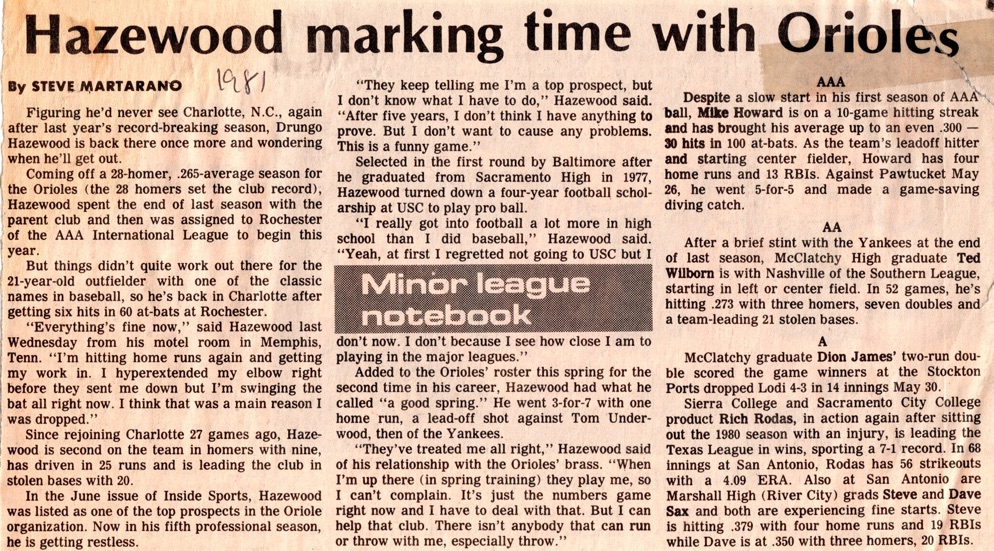
Potter tracking down the legend of Drungo Hazewood

A rare signed Drungo Hazewood 1991 Crown Orioles Card
Drungo Hazewood’s major league baseball career lasted five plate appearances, and if you weren't scouring box scores in 1980, chances are slim that you've ever heard of him. Yet when it comes to serious fans and collectors of Baltimore Orioles memorabilia, Hazewood has remained famous for more than his unique moniker. Just like the curve balls that baffled the highly touted outfielder, he has thrown some of his own to those seeking his signature, placing his name atop the want lists of collectors across the country.

In his travels connecting retired major leaguers with aficionados looking to further their autograph collections, Chris Potter met with the elusive Hazewood to discuss the prospects of facilitating a signing to add his penmanship to their prized paraphernalia. “I brought it up to him, I said, ‘You’ve been a pretty tough autograph for people that want it,’” said Potter. “He goes, ‘I just don’t understand why they want it.’ – He just doesn’t understand why people want his autograph from the career that he had. He didn’t have a long career. He’s kind of taken back by the fact that people want his autograph. He’s more than happy to do the signing with me; he was excited about it when I mentioned it to him. He wants to see what people are going to send in to be signed.”

Hazewood is one of 50 former major leaguers that Potter will visit during his next run of signings beginning September 30th that include a wide range of talents from Hall of Famer Rollie Fingers, perennial All-Stars Del Crandall, Reggie Smith, and Don Kessinger, to such curiosities as Frank Baker, Rich Coggins, Johnny Jeter, and Ron Woods. The one-time Orioles prospect is not the first player to wonder why people still want their autograph long after their cup of coffee has been emptied. “I’ve run across that a few times where players are like, ‘Who remembers me and why do people want my autograph?’” said Potter. “The people who are really seeking their autograph know who they are, but it’s really hard to find someone who knows about the players I go and see unless you are a baseball enthusiast, historian or collector. We focus more on those guys.”

For many of the players Potter visits, they enjoy the convenience of being able to do the signing in a comfortable setting while obliging the fans. “Everybody I’ve worked with really enjoys this. If you look at it, they don’t have to go anywhere and guys their age, they don’t like to travel. Not only are we providing a service to the collectors, we are providing a service to the players as well. That’s what is appealing to a lot of these guys. They want to accommodate the fans and they want to go to these shows, but some are physically unable to do so. With the service we provide, they’re able to accommodate the fans and they’re happy to do so with what we provide,” said Potter.

As he continues with traversing the routes and highways of the United States, he finds the players revel in the uniqueness of the items they’re presented with. “We get it all the time. They’re taken a back from some of these items and by people who track this stuff down, are passionate enough to get it signed, and want their autograph on it. Some of the guys are really emotional about the things we bring them to be signed.” For more information on Potter’s next round of signings, check out his website – www.chrispottersports.com

Friday, August 31, 2012

New York Mets family loses two pitchers, Bob Myrick and Harry Parker

A sad week for New York Mets fans, as the deaths of former pitchers Bob Myrick and Harry Parker were announced this week.


Parker was a right-handed pitcher for the New York Mets from 1973-75, pitching in three games in the 1973 World Series against the Oakland Athletics. Parker was the hard luck loser in Game 3, when catcher Jerry Grote dropped the third strike on Angel Mangual, allowing Mangual to reach base and advancing Ted Kubiak into scoring position. Kubiak scored during the next at-bat when Bert Campaneris singled him home for the winning run. Parker passed away on May 29th, 2012, but reports of his death only surfaced this week.


Myrick was a promising left-handed reliever out of Mississippi State University who pitched from 1976-78 with the Mets. Myrick was a favorite of Mets manager Joe Frazier, who brought the lefty to the big leagues after pitching for him in Tidewater the previous season. Myrick passed away August 23rd in Hattiesburg, Mississippi, after suffering a heart attack.


Monday, August 27, 2012

Dwight Gooden's first career home run

Dwight 'Doc' Gooden's amazing talent as a pitcher with the New York Mets have been well heralded throughout the years; however, Gooden took tremendous pride in his prowess at the plate. He belted eight home runs during his career while finishing just below the Mendoza Line with a .196 batting average. The video below shows the first home run of Gooden's career, which came on September 21st, 1985 at Shea Stadium off of Rick Rhoden.

Courtesy of CourtsideTweets on Youtube -


Monday, August 13, 2012

Frank Evans, 90, played in the Negro Leagues and coached in the Cardinals organization

Frank Evans stayed with the game he loved until the day he died. The former Negro League player and longtime scout and coach for the Louisville Redbirds of the St. Louis Cardinals organization passed away August 3rd in Opelika, Ala., at the age of 90.

Frank Evans 1985 Louisville Redbirds Card
Evans began his playing career as a teenager in 1937 and stayed active well into his 40s, playing as an outfielder, first baseman, and catcher with the Birmingham Black Barons, Cleveland Buckeyes, and the Kansas City Monarchs of the Negro Leagues. After the color line broke, Evans batted .313 in a short stint with Class C minor league teams in Port Arthur and Borger, Texas in 1954 at the age of 32.

Well after he hung up his glove and cleats, Evans was recruited by major league All-Star and future big league manager Jim Fregosi to be his first base coach in Louisville for the 1984 and 1985 seasons. Infielder Willie Lozado who played under the tutelage of Evans in 1985, said via e-mail that he brought a great amount of spirit to the clubhouse.

"Frank was a good man that always had something positive to say," Lozado wrote. "He will be missed."

A few of Evans’ other prized pupils during that time were Vince Coleman, Terry Pendleton, and Jose Oquendo, all of whom would figure prominently in the Cardinals 1987 National League pennant-winning team.

A few years back, I called Evans at his home in Alabama to discuss his career in the Negro Leagues. My recorder wasn’t working, so I just tried to soak in his vast experiences the best I could. This was at the time of President Obama’s election, and Evans was enthusiastic about his chances, a far cry from the segregation he faced in his youth. He spoke of the long bus rides, hanging his uniform outside the window while traveling to the next city, all with the hope that they might be able to find a place that would feed them while they filled up for gas. Even with the harsh indignities that he faced as a player, Evans remained enthusiastic about the game, telling me of a baseball clinic he finished a few days ago.

As our conversation progressed and I told him that I still played, he even offered me the opportunity to visit him in Alabama to help with my swing. He assured me with a few days of work that he could turn around my fortunes at the plate. I kept his number in my phone, knowing that if I ever made it down that way, that I could grab some hitting advice that I could not only use but also pass on to my players. Even though I didn’t visit, the offer of help to someone he had just encountered on the phone only thirty minutes prior spoke volumes about his generosity and love for the game.


The Topps Company honored Evans in their 2009 Allen and Ginter set, providing him with his first nationally issued baseball card. Evans was once again in the spotlight, allowing him the opportunity to not only provide his autograph, but to further spread the word about the greatness of the Negro Leagues.

Wednesday, August 8, 2012

R.A. Dickey teaches the tricks of the knuckleball at Citi Field Kids event

New York Mets pitcher R.A. Dickey has been prolific in spreading the word about his knuckleball this season, publishing his best-selling book, Wherever I Wind Up, and appearing in the Knuckleball documentary, which was a smash at this year’s Tribeca Film Festival. Wednesday afternoon, Dickey took a more local approach, conducting a clinic for over 100 kids at the Jacob A. Riis Neighborhood Settlement House in Long Island City. The event, which was hosted by SNY anchor Michelle Yu, was part of the Citi Field Kids program, an initiative formed by the Mets, Citi and the Jackie Robinson Foundation

Click here to see read more about Dickey's participation in the clinic as well a video interview with Dickey about the the impact of his book and his thoughts on being able to participate in the clinic.

Tuesday, August 7, 2012

Franco continues to represent as an ambassador for the New York Mets

John Franco is the epitome of New York baseball. Born and raised in Brooklyn, the Lafayette High School graduate went on to play at St. John's University in Queens before being drafted by the Dodgers in 1981. Little did he ever imagine that he would play 15 years in the major leagues with the New York Mets and earn a spot in their Hall of Fame. Earlier this year, Franco was inducted into the Mets Hall of Fame in a wonderful ceremony at Citi Field. A few months later, he’s still amazed at the honor.
John Franco Signing Autographs / N. Diunte
“If you would have told me as a kid growing up that I would be in the Mets Hall of Fame, I’d say you were crazy,” said Franco at his Tuesday afternoon appearance at Citibank in Tarrytown, N.Y. “It’s a great honor to be on that wall and [have] my plaque next to great players like Tom Seaver, Jerry Grote, Bud Harrelson, Tommie Agee, all my heroes growing up. ... It’s a great honor, I’m humbled and I’ll truly cherish it.”

The subject of the Hall of Fame this year for Franco is one that hits close to home, as his former Cincinnati Reds teammate Barry Larkin was inducted into the National Baseball Hall of Fame a few weeks ago.

“Barry, you knew he was going to be something special when he came up to the big leagues early," Franco said. "He had a five tools [as a] player, speed, he could hit with power, a great fielder, great arm, and [was] very very smart. It was just an honor to play with Barry and I’m happy that he got into the Hall of Fame; he deserved it.”

Franco, like many of his Brooklyn brethren, honed his skills at the famous Parade Grounds. Even though the diamonds were a little rough, they still provide Franco with the opportunity to develop and mature as a player.

“Back then, the fields weren’t in great shape, but there were always games going on," he said. "There were seven or eight diamonds, and at every field, a game was going on. You’d start at nine in the morning and sometimes play until three in the afternoon. You’d go from field to field or play doubleheaders. It was a great experience, great baseball in the New York City area. We had some great teams from all over Brooklyn and it was very competitive.”

Currently, Franco works as an ambassador for the Mets and keeps busy by making appearances all over the city.

“This is my 3rd year with the Mets [as] one of their ambassadors," he said. "What I do, I go around to the various [Citi] branches … and they have these branches that myself and other veteran, retired players who are involved with the Mets go around and do some signings. I get to meet and greet the fans and talk a little bit about baseball. I go into the community, do some community service, some baseball stuff, some announcing, and some TV stuff; a little bit of everything.”

Monday, July 30, 2012

Ed Stevens, 87, Brooklyn Dodgers and Pittsburgh Pirates first baseman told the other side of the Jackie Robinson story

Ed Stevens was the starting first baseman for the Brooklyn Dodgers in 1946, finishing second on the team in home runs and was looking forward to cementing his feet in the first base position for years to come. Leaving spring training in Havana in 1947, Leo Durocher had penciled him in as their opening day starter, beating out five other first baseman in the process.

Ed Stevens
Left with little time to glow in the fruits of his hard work, Stevens’ jubilee would quickly turn sour as the day before the season opener, Dodgers general manager Branch Rickey announced that Jackie Robinson, not Stevens would be their opening day first baseman. Not only was Stevens about to witness Robinson break baseball’s color line, he also saw his position wither away right in front of his eyes.

“I would like to say that I realized the magnitude of the situation and happily stepped aside, accepting my role as the sacrifice in this incredibly significant moment in history. But the truth is, I was a competitor, and I was agitated. The fact remained coming out of spring training the starting first base job was mine, and the rug had been ripped out from under me,” Stevens said in his 2009 autobiography, “Big” Ed Stevens - The Other Side of the Jackie Robinson Story.

Stevens, who passed away last week at the age of 87 in Galveston, Texas, was more than a mere footnote in baseball’s most significant event. He survived a near-fatal infection to have a 19-year professional career as a player that included six in the majors with the Dodgers and Pittsburgh Pirates from 1945-1950.

“It wasn't the fact that I lost my job [in Pittsburgh], I couldn't handle my job because my health went bad on me. I had a poison in my body that was affecting every joint in my body. It took me four years and 29 doctors to find out,” Stevens said during a 2008 interview from his home in Galveston. “I had my nose broken two different times. I couldn't breathe out of my left side. My doctor in Shreveport, La., said, 'I don't know what the problem is with all of the pains you have, but I'm going to straighten your nose out so you can breathe a lot better.’ When he had the nose broken down, he could see up in my head and that's where he found the poison. As soon as he finished my nose and let it rest, he went back with a long curved knife, a mirror and a light to get up in there and cut all that out. He filled a whiskey glass with it. It was all poisonous puss, and he said if it would have hit me all at once, it would have killed me.”

Stevens regained his strength and within a few years, he was among the home run leaders in Triple-A, yet he wondered why nobody would take a flyer on him.

“I put in about five years in Toronto in Triple-A, and had good years every year, drove in about 100 runs, hit 25-30 home runs, and played in every ball game," he said. "The scouts coming through said I could still play big league ball, but they were afraid to recommend me because I left [the majors] as a cripple. They were afraid that all of that would come back on me. That's what kept me out.”

Stevens played in the minor leagues until 1961 and became a scout for various organizations from 1962-1989. Once he was on the other side of the table, it was clearer to him why he didn’t get another shot at the big leagues.

“I went into scouting as soon as I left baseball," he said. "When I started scouting, then I realized what the scouts were up against. You have to be sure a fellow is good and healthy before you make a deal for him or sign him. That's what it boiled down to. I forgave all of the scouts.”

Despite playing six seasons in the majors, Stevens was ironically 42 days short of his major league pension. While scouting for the San Diego Padres, general manager Jack McKeon caught wind of this and asked Stevens in 1981 to join his team as a bench coach.

“In order for me to be the fifth [coach], one had to take himself off the pension plan," Stevens said in his autobiography. "Eddie Brinkman, one of the finest people I have ever met, volunteered. I will always respect that man as a gentleman and a friend. … After thirty years, I finally had the major league pension plan.”

With the publishing of his memoirs, Stevens wanted to make it clear that he didn’t harbor ill will towards Robinson, but towards management for removing Stevens after promising him the position a few days prior.

“I had no animosity towards Jackie; Branch Rickey was my object of anger. ... I’m proud of Jackie, but I still wish we could have truly competed for that spot.”

In retirement, Stevens continued to receive large amounts of fan mail, something that brought him much joy and satisfaction.

“If you’re a good enough fan and think enough of me to request this, I’m glad to do it,” he said. “We’re still being remembered, [and] I appreciate every one of those people that takes the time to write and remember.”

Friday, July 27, 2012

Red Sox manager Morgan receives royal treatment at Irish American Baseball HOF ceremonies

With the Boston Red Sox in town to face the New York Yankees, fans put aside their rivalries for the afternoon and honored former Red Sox manager Joe Morgan on Friday at the induction ceremonies for the Irish American Baseball Hall of Fame at Foley’s Pub and Restaurant in New York City. The 81-year-old Morgan was the center of attention at the event, which also featured the inductions of former Yankees Gene Michael, Jeff Nelson, Wee Willie Keeler as well as legendary New York sportswriter Jimmy Breslin.

“It’s really terrific because I never thought there would be one,” Morgan said. “ I’ve known Shaun [Clancy] for so long and all of a sudden he calls me up and gives me the good news. Next thing you know, here I am, and I’ve enjoyed it a ton.”
Joe Morgan accepts his plaque from the Irish American Baseball HOF

The Walpole, Mass., native had his start in baseball at Boston College, where he was signed by his hometown club. Only this time, it wasn’t the Red Sox, it was their National League counterpart, the Braves.

“I was in Boston College and I was one of the first guys that left school [early],” he said. “I left at the end of my junior year because I got a bonus and that was 1952.” 

Morgan played two years for their minor league clubs before Uncle Sam called. He spent the next two years in the military, which Morgan said was to the benefit of his baseball career.

“It really helped me,” he said. “ I was lucky, I played a lot of baseball at Fort Sill in Oklahoma, and I tried things I never would have tried. I knew I was a lot better hitter [than what I showed]. I hit .228 and .249 the first two years [before I went into the military]. When I came out, I hit .301, and .316 and I was on my way.”

Morgan made his debut with the Braves in 1959, making the club out of spring training. He played sparingly during the first two months of the season and was traded to the Kansas City Athletics. The Braves finished tied for the National League pennant with the Los Angeles Dodgers and lost a best-of-three game playoff to go to the World Series. Even though Morgan was long gone, the Braves still remembered his contributions to the team at the end of the season.

“I was with the Braves during that year in ‘59 when they lost the playoffs to the Dodgers,” he said. “I was with them for five weeks and they were good enough to give me a quarter share [of the playoff bonus]. That was something! I was rooting for them big that time. I was the lowest guy on the totem pole and they took care of me.”

Morgan was then shuttled between the Cleveland Indians and Philadelphia Phillies for the next few seasons before landing with the St. Louis Cardinals for a brief appearance in 1964 at the end of their World Series run. The Cardinals wanted Morgan on the postseason roster to replace an injured Julian Javier, but the Yankees wouldn’t budge.

“Now there’s a story there,” he said. “I came up September 10th. Julian Javier got hurt; he pulled a rib cage muscle and he could not play in the World Series, so the Cardinals said, ‘We want to put Joe Morgan on as the 25th player.’ The Yankees said, ‘No way, because he didn’t come up by September 1st.’ That was the rule. They went with 24 players (Javier made only one appearance as a pinch runner) and kicked the s—t out of the Yankees.”

He started his managerial career in 1966 as a player-manager in Raleigh, N.C., with the Pirates and spent the next 26 seasons as a scout, coach and manager, taking the reins of the big league club from John McNamara from 1988-1991. He led the Red Sox to two first place finishes in the American League East during his time as manager. Morgan was ready for the task; the only difference he saw was scale.

“The biggest difference managing in the majors was that they gave me a hell of a lot of money, [something] which I never saw in 30 years in the minor leagues. … I knew the writers and how they operated. I was ready for all of that.”

Morgan, who was a two-sport star in both hockey and baseball, is an institution in his hometown and stays active visiting local high school games. Even though he is easily recognized in the town of Walpole, he still receives fan mail that is intended for the “other” Joe Morgan.

“It’s nice to be remembered,” he said. “I get mail every day. I also get a lot of mail for [Hall of Famer] Joe Morgan, so I write out; try 3239 Danville Blvd, Alamo, CA 94507 - from Joe Morgan manager Boston Red Sox.”

Thursday, July 26, 2012

Harrelson continues to nuture the Long Island Ducks at Hofstra seminar

Thursday morning, Bud Harrelson presided over the Hofstra University Club as part of the Operation Downtown Seminar entitled, The Birth of Long Island Ducks Baseball. The presentation, which was sponsored by the Scott Skodnek Business Development Center and Astoria Federal Savings, was attended by over 100 leaders in a variety of Long Island businesses.

Bud Harrelson / N. Diunte
Harrelson has been part of the ownership groups of the Long Island Ducks since their inception in 2000. Despite his two World Series rings with the New York Mets during his major league tenure (one as a player in 1969 and one as a coach in 1986), Harrelson cited this chapter of his baseball life as the most fulfilling.

“I’m often asked about my best accomplishment in baseball and I answer, ‘The Long Island Ducks.’ I say it is the best thing I’ve ever done because the fans know me, and I know them.”

Now that the Ducks are firmly entrenched in the community, fan support hasn’t wavered. “We have affordable family entertainment, less than the cost of a movie. We are approaching six million fans in career attendance, and stand in the upper ten percent in minor league attendance,” said Harrelson.

The Ducks are an independent team in the Atlantic League, which means that they aren’t tethered to any major league club. As they have grown, the Ducks have become a magnet for high caliber talent.

“We look at those players who are the non-roster invitees to spring training," he said. "Those are the guys we want. When we started, we really had to go after ex-major league players, now their agents are calling us.”

Despite a league maximum salary of $3,000 per month, former major leaguers are willing to play with the Ducks because of their reputation of getting players back into a major league organization.

“In the last ten years, we’ve had over 50 contracts purchased by MLB organizations. We are warehousing players, but every time one leaves, another one comes.”

Wednesday, July 25, 2012

1973 NL champs Millan and Staub wax poetic about the current state of the Mets

The current saga of the New York Mets were on the minds of Felix Millan and Rusty Staub, two key players from their 1973 National League Championship team, as they interacted with fans on Tuesday afternoon as part of the Mets Alumni Association Presented by Citi and the Citi Tuesdays program.